
Mimic octopus
흉내문어
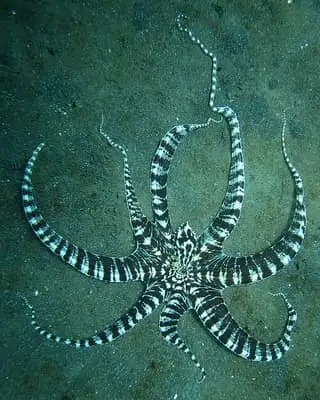
An octopus that imitates other animals, such as a venomous lionfish, a sea snake or a flatfish, by changing its colour, shape and movement. First reported off Indonesia in 1998, it lives on muddy seabeds and fools predators.
See it on the 3D globe →At a glance
- Class
- Molluscs
- Diet
- Meat eater (carnivore)
- Habitat
- coasts, coral reefs
Quick answers
Where does the Mimic octopus live?
It lives in coasts, coral reefs of the Pacific and Indian oceans.
What does the Mimic octopus eat?
Its diet: meat eater (carnivore).
The mimic octopus is a small octopus from the warm Indo-Pacific region. Scientists first found it in 1998 off Sulawesi in Indonesia, on a muddy seabed near a river mouth. It grows to about 60 centimetres long including its arms.
Its trick is copying other animals. By changing its colours, body shape and way of moving, it can pretend to be a venomous lionfish, a sea snake or a flatfish, which many predators avoid. Most sightings come from Indonesia. It is smaller than many octopuses, and each arm can be around 25 centimetres long. Scientists named it in 2005, several years after the first sightings. Even a fish has been seen copying the mimic octopus.
Where does it live?
The mimic octopus lives across the Indo-Pacific, from the Red Sea and Gulf of Oman in the west to New Caledonia in the east. It likes sandy or silty bottoms at depths shallower than about 15 metres. Unlike many octopuses that hide in reefs, it prefers river mouths and estuaries. It glides over the sand by squirting water through its funnel while it hunts small fish, crabs and worms. The species may live as deep as 37 metres, but most sightings are on shallow sand or mud where the octopus is easy to watch. It is active mainly in the daytime.
How does it imitate other animals?
Like other octopuses it has colour-changing skin cells, but this species goes further. Its natural colour is light brown or beige, yet it often shows bold white and brown stripes, like poisonous animals. It has been seen mimicking lionfish, flatfish, sea snakes and more. The trick works because predators learn to avoid the real, dangerous animals. Korean Wikipedia counts at least 18 animals that it imitates, including jellyfish. At night it does not seem to imitate other animals.
Fun facts
- It imitates dangerous animals such as lionfish, sea snakes and flatfish to scare off predators.
- Only the mimic octopus and its close relative the wunderpus are known to imitate several different animals to escape predators.
- The species was first discovered in 1998 on a muddy seabed off Sulawesi.
- A mimic octopus is about as wide as a pencil at the widest part of its body.
On the globe
The model shows a mimic octopus on the seabed, ready to shape its arms and colour like another animal.
More like this

Sources
Updated: 2026-10-14