
Gharial
가비알
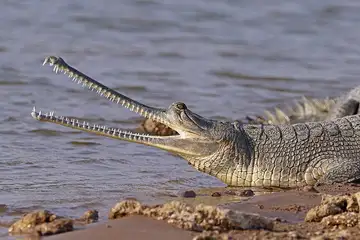
A crocodilian of Indian rivers with a very long, thin snout built for catching fish. Adult males grow a bulb on the tip called the ghara, used to buzz and attract mates. Only about a thousand remain, so it is critically endangered.
See it on the 3D globe →At a glance
- Class
- Reptiles
- Lives in
- Chambal River, northern India
- Diet
- Fish eater
- Length
- about 4 m
- Conservation status
- Critically Endangered (IUCN CR)
- Habitat
- rivers & lakes
Quick answers
Where does the Gharial live?
It lives in rivers & lakes. On the globe you can find it near Chambal River, northern India.
How big is the Gharial?
It grows to about 4 m.
What does the Gharial eat?
Its diet: fish eater.
Is the Gharial endangered?
It is listed as Critically Endangered (IUCN CR).
The gharial is a crocodilian of the rivers of the northern Indian subcontinent. It is among the longest crocodilians alive: females are 2.6 to 4.5 metres long and males 3 to 6 metres. Its very long, narrow snout with 110 sharp, interlocking teeth is built for catching fish.
Adult males grow a round lump on the snout tip called a ghara, after the Hindustani word for an earthen pot. Our card says males use it to make buzzing sounds that attract mates. Gharials are the most thoroughly aquatic of the crocodilians, leaving the water only to bask and nest on sandbanks. The IUCN has listed the species as critically endangered since 2007.
Life along the river
Mating takes place at the end of the cold season. In spring, females gather to dig nests and lay 20 to 95 eggs, then guard the nests and the young. The hatchlings emerge before the monsoon starts and spend their first year foraging in shallow water, moving to deeper places as they grow. The ancestors of the gharial probably evolved in the northern Indian subcontinent, and fossils have been found in the Sivalik Hills and the Narmada River valley.
Why is it so rare?
The wild population has fallen sharply since the 1930s, and the gharial now lives in only about 2 percent of its old range. Sand mining, farming that takes over the riverbanks, fewer fish and harmful fishing methods are still threats. Since the early 1980s, India and Nepal have released captive-bred gharials into rivers. The animal also has a place in culture: the oldest pictures of it are about 4,000 years old and come from the Indus Valley, and Hindus see it as the vehicle of the river goddess Gaṅgā.
Fun facts
- Adult males have a pot-shaped knob on the tip of the snout called a 'ghara', which gives the gharial its name.
- It has 110 sharp, interlocking teeth.
- Its name comes from the word 'ghara', a clay pot, because of the lump on a male's snout.
- Pictures of gharials about 4,000 years old were found in the Indus Valley.
On the globe
The toy model of the gharial lies by the Chambal River in northern India. Look for the very slim snout and, on an adult male, the round lump at its tip.
Quiz time
Which is longer: Gharial or Indian cobra?
Show the answer
Gharial. (4 m vs 1.3 m) Indian cobra →
More like this
_female_head.jpg)
Sources
Updated: 2026-10-14