
Hawksbill sea turtle
대모(대모거북)
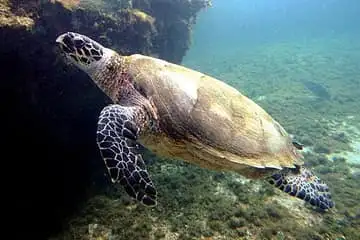
The hawksbill sea turtle has a narrow, hawk-like beak that lets it reach sponges in coral crevices. Its patterned shell was once heavily hunted, and it is now critically endangered. Adults weigh roughly 60 to 80 kg.
See it on the 3D globe →At a glance
- Class
- Reptiles
- Conservation status
- Critically Endangered (IUCN CR)
- Habitat
- coral reefs, coasts
Quick answers
Where does the Hawksbill sea turtle live?
It lives in coral reefs, coasts of the Pacific, Atlantic and Indian oceans.
Is the Hawksbill sea turtle endangered?
It is listed as Critically Endangered (IUCN CR).
The hawksbill sea turtle is a sea turtle with a narrow, sharply curved beak like a hawk's, which is how it got its name. Its shell has overlapping plates that look like roof shingles, with a saw-toothed back edge. Adults are about 1 metre long at most and usually weigh around 60 to 80 kilograms.
It lives in the tropical seas of the Pacific, Atlantic and Indian Oceans, mostly in shallow lagoons and coral reefs. It is Critically Endangered, mainly because of human fishing and hunting. It spends more time in shallow lagoons and coral reefs than in the open ocean.
A beak made for sponges
The thin beak can poke into cracks in the reef to reach sponges, the hawksbill's main food. Many sponges are poisonous to other animals, but the hawksbill can eat them.
It also eats small fish, jellyfish and sometimes seagrass, so it counts as an omnivore. The largest hawksbills can weigh as much as 127 kilograms. Their sponge diet is rich in silica, which few other animals can eat.
Tortoiseshell trouble
The hawksbill's beautiful patterned shell was once the main source of tortoiseshell, used for combs and jewellery. Hunting for it brought the turtle close to extinction.
The trade is now regulated by the international agreement CITES, which forbids catching hawksbills or selling products made from them. Its name Eretmochelys comes from Greek words meaning oar and turtle, for its oar-like front flippers.
Fun facts
- Its patterned shell was once the main source of the 'tortoiseshell' used in combs and jewellery.
- Its beak looks like a hawk's, which gave the turtle its name.
- Its shell plates overlap like roof tiles.
- It eats sponges that are poisonous to many other animals.
On the globe
The globe places the hawksbill sea turtle on tropical reefs. Look for the narrow beak and the patterned shell.
More like this

Sources
Updated: 2026-10-14