
Nile crocodile
나일악어
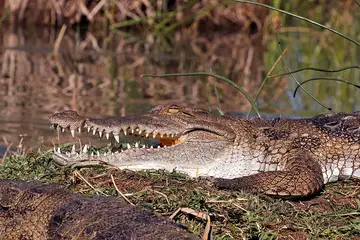
The Nile crocodile is Africa's largest crocodile, basking on river and lake shores. Adults reach about 4 to 5 metres long and ambush animals that come to drink, even large ones such as wildebeest.
See it on the 3D globe →At a glance
- Class
- Reptiles
- Lives in
- Nile River and African rivers and lakes
- Diet
- Meat eater (carnivore)
- Weight
- about 300 kg
- Length
- about 3.6 m
- Top speed
- about 35 km/h
- Lifespan
- up to about 70 years
- Conservation status
- Least Concern (IUCN LC)
- Habitat
- rivers & lakes, wetlands, savannas
Quick answers
Where does the Nile crocodile live?
It lives in rivers & lakes, wetlands, savannas. On the globe you can find it near Nile River and African rivers and lakes.
How big is the Nile crocodile?
It grows to about 3.6 m and 300 kg.
What does the Nile crocodile eat?
Its diet: meat eater (carnivore).
How fast is the Nile crocodile?
It can reach about 35 km/h.
How long does the Nile crocodile live?
It can live up to about 70 years.
Is the Nile crocodile endangered?
It is listed as Least Concern (IUCN LC).
The Nile crocodile (Crocodylus niloticus) is a large crocodilian that lives in freshwater habitats in 26 countries of Africa. It is widespread in sub-Saharan Africa, mostly in the east, south and centre of the continent, in lakes, rivers, swamps and marshes. It sometimes visits deltas and brackish lakes, and rarely the sea. Its range once stretched from the Nile Delta all the way along the Nile.
An adult male is usually 3.5 to 5 metres long and weighs 225 to 750 kilograms, though some larger than 6 metres and 1,000 kilograms have been recorded. It is Africa's largest predator and may be the second-largest living reptile, after the saltwater crocodile. Females are usually about 30 percent smaller. Lake Turkana in Kenya has one of the largest undisturbed populations. The species is common and not endangered, though it has disappeared locally in parts of the Maghreb.
An ambush hunter
The Nile crocodile is an opportunistic top predator that can take almost any animal in its range. Its diet is mostly fish, reptiles, birds and mammals. As an ambush predator it can wait for hours, days or even weeks for the right moment to strike, until prey comes well within reach, and even swift prey is not safe.
Its bite is powerful, and its sharp, cone-shaped teeth sink into flesh and hold on almost impossibly tightly. It can hold large prey underwater until it drowns. It is one of the most dangerous crocodiles and is blamed for hundreds of human deaths every year.
Colours and a rough name
Adults are dark bronze above with faded blackish spots and stripes, and dingy yellow underneath, though mud often hides the real colour. The sides are yellowish-green with dark oblique stripes, and the eyes are green. Crocodiles from fast, clear water tend to be paler than ones from murky lakes, which helps them blend in.
Young crocodiles are grey, brown or multicoloured with dark bands on the tail and body, and they darken as they grow. The name Crocodylus comes from Greek words meaning pebble and worm, for the rough skin, and niloticus means from the Nile. In Swahili it is called mamba.
Sharing and parenting
Nile crocodiles are fairly social. They share basking spots and large food such as schools of fish or big carcasses. Size decides a strict pecking order, and large old males get first pick of food and the best basking spots. Breaking the order often ends in violence.
They lay eggs, and both females and males guard them, which is rare for reptile males. The hatchlings are protected for a while but hunt for themselves and are not fed by their parents. Sexual maturity arrives at 12 to 16 years of age, and a female of about 3.6 metres can lay up to 95 eggs in one clutch.
Fun facts
- A mother Nile crocodile gently carries her newly hatched babies to the water in her jaws.
- Its range once stretched from the Nile Delta throughout the Nile River.
- Some Nile crocodiles top 1,000 kilograms.
- It is present in 26 countries.
- Its skin has sense organs that may feel water pressure and help it track prey moving in the water.
On the globe
The model shows a Nile crocodile resting on a river bank.
Quiz time
Which is heavier: Nile crocodile or Loggerhead sea turtle?
Show the answer
Nile crocodile. (300 kg vs 135 kg) Loggerhead sea turtle →
More like this
.jpg)
Sources
Updated: 2026-10-14