
Indian cobra
인도코브라
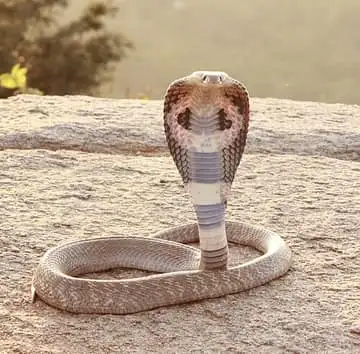
When threatened the Indian cobra rears up and spreads its hood, showing a spectacle-shaped mark on the back. It mostly eats rats and frogs, which helps farmers, and its venom attacks the nervous system.
See it on the 3D globe →At a glance
- Class
- Reptiles
- Lives in
- Rajasthan, India
- Diet
- Meat eater (carnivore)
- Weight
- about 2.5 kg
- Length
- about 1.3 m
- Lifespan
- up to about 30 years
- Conservation status
- Least Concern (IUCN LC)
- Habitat
- grasslands, forests, towns & cities, wetlands
Quick answers
Where does the Indian cobra live?
It lives in grasslands, forests, towns & cities, wetlands. On the globe you can find it near Rajasthan, India.
How big is the Indian cobra?
It grows to about 1.3 m and 2.5 kg.
What does the Indian cobra eat?
Its diet: meat eater (carnivore).
How long does the Indian cobra live?
It can live up to about 30 years.
Is the Indian cobra endangered?
It is listed as Least Concern (IUCN LC).
The Indian cobra, also called the spectacled cobra, is a venomous snake of the Indian subcontinent. When threatened it lifts the front of its body and spreads a wide hood. On the back of the hood many have a mark made of two round spots joined by a curved line, which looks like a pair of spectacles.
Most adults are 1 to 1.5 metres long. The species is one of India's Big Four snakes, the ones responsible for most snakebites in India and Sri Lanka. It is protected under India's Wildlife Protection Act of 1972, and it is honoured in Hindu myth and culture. It is a different animal from the much longer king cobra.
What it looks like and eats
The Indian cobra is a moderately sized, heavy-bodied snake with an oval head that is only slightly wider than the neck, a short rounded snout and round pupils. The scientific name Naja comes from the Sanskrit word naga, meaning cobra. As the globe card explains, it mostly eats rats and frogs, which helps farmers by keeping pests down. Its venom attacks the nervous system, so a bite needs urgent medical care.
Naming and culture
Carl Linnaeus described the species in 1758. For a long time all Asian cobras were treated as one species, but many of the old subspecies were later found to be separate species, which can confuse older books. In India the snake appears in religion and folklore and in the tradition of snake charmers. Staying calm and keeping a distance is the safest response if you meet one.
Fun facts
- It is one of India's 'Big Four' snakes, which cause most snakebites in the country.
- The spectacle-like mark on its hood gives it the name spectacled cobra.
- Its genus name Naja comes from the Sanskrit word for cobra.
- It is one of India's Big Four snakes responsible for most snakebites.
On the globe
Look in Rajasthan, India; the card shows the raised hood with the spectacle mark.
Quiz time
Which is heavier: Indian cobra or King cobra?
Show the answer
King cobra. (2.5 kg vs 6 kg) King cobra →
More like this

Sources
Updated: 2026-10-14