
Grey reef shark
회색산호상어
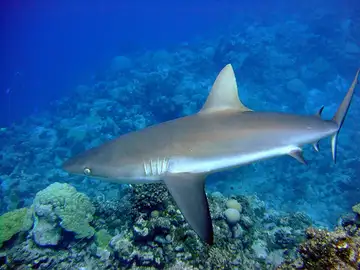
A slim reef shark about 2 m long with a black trailing edge on its tail fin. When threatened it warns intruders by arching its back, dropping its pectoral fins and swimming in jerky loops.
See it on the 3D globe →At a glance
- Class
- Fish
- Lives in
- Coral reefs of the Indian and Pacific Oceans
- Diet
- Meat eater (carnivore)
- Length
- about 1.7 m
- Conservation status
- Endangered (IUCN EN)
- Habitat
- coral reefs
Quick answers
Where does the Grey reef shark live?
It lives in coral reefs of the Indian and Pacific oceans. On the globe you can find it near Coral reefs of the Indian and Pacific Oceans.
How big is the Grey reef shark?
It grows to about 1.7 m.
What does the Grey reef shark eat?
Its diet: meat eater (carnivore).
Is the Grey reef shark endangered?
It is listed as Endangered (IUCN EN).
The grey reef shark is a sleek, fast reef shark of the Indian and Pacific Oceans. Most are less than about 1.9 metres long. It has a broad, round snout, big eyes and a tail fin with a wide black edge at the back, which helps tell it from similar sharks.
It is one of the most common reef sharks in the Indo-Pacific, living from South Africa all the way to Easter Island. It is usually seen in shallow water near the drop-offs at the edge of coral reefs, where it hunts fish and squid. It is a strong swimmer and is bold enough to dominate other sharks on the reef.
A shark that warns first
The grey reef shark was the first shark known to perform a threat display. If a diver follows or corners it, it arches its back, lowers its pectoral fins and swims in jerky side-to-side loops.
This display is a warning to back off. Divers who see it should leave the shark plenty of space and swim away calmly. It has been involved in a number of attacks on humans, so divers treat it with respect.
Life on the reef
During the day, grey reef sharks often rest in groups of five to 20 near a reef drop-off. In the evening they split up to hunt. Many return to the same part of the reef again and again.
Females give birth to live pups, one to six at a time, about every other year. The IUCN lists the species as Endangered. Adult females also gather in very shallow water, where the warmer water may help their pups grow.
Fun facts
- Before attacking it may give a warning display, arching its back and lowering its fins.
- It was the first shark known to do a threat display.
- Groups of 5 to 20 gather by day and split up to hunt at night.
- The broad black edge on its tail fin is a good clue to its name.
On the globe
The globe places the grey reef shark on coral reefs in the Indian and Pacific Oceans. Look for the black edge on the tail.
Quiz time
Which is longer: Grey reef shark or Bull shark?
Show the answer
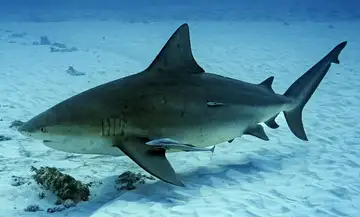
Bull shark. (1.7 m vs 2.3 m) Bull shark →
More like this

Sources
Updated: 2026-10-14