
Mariana snailfish
마리아나꼼치
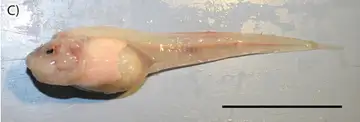
A pale, tadpole-shaped fish that lives in the Mariana Trench at depths of about 6,000 to 8,000 m, the deepest known fish. Its scaleless, gelatinous body helps it withstand the huge pressure, and it grows to about 30 cm.
See it on the 3D globe →At a glance
- Class
- Fish
- Lives in
- Mariana Trench
- Diet
- Meat eater (carnivore)
- Length
- about 0.29 m
- Habitat
- deep sea
Quick answers
Where does the Mariana snailfish live?
It lives in deep sea of the Pacific Ocean. On the globe you can find it near Mariana Trench.
How big is the Mariana snailfish?
It grows to about 0.29 m.
What does the Mariana snailfish eat?
Its diet: meat eater (carnivore).
The Mariana snailfish (Pseudoliparis swirei) is a pale, tadpole-shaped fish that lives in the Mariana Trench in the western Pacific Ocean. It is known from depths of about 6,200 to 8,076 metres, including one caught at 7,966 metres, which is possibly the record for a fish caught on the seafloor. Scientists call these very deep parts of the ocean the hadal zone.
It grows up to 28.8 centimetres long and 160 grams. In some stretches of the trench it seems to be the top predator, feeding on tiny crustaceans in a deep home with few larger hunters. It is abundant there, and its eggs are relatively large, almost 1 centimetre across.
How it was found
The first specimens were caught in 2014 during an expedition of the research vessel Falkor. Scientists used deep-water traps designed to protect the fish on the long trip up, baited with mackerel. The first fish came up on 15 November 2014, and 35 more followed in the next ten days.
Catching hadal fish is hard, because trawl nets bring up very few and in poor condition. The first named specimen, the holotype, was a young fish caught on 21 November 2014 at 7,949 metres. Another was caught in January 2017 by the research ship Shinyo-maru.
Built for the deep
Compared with snailfish from shallow water, this fish has several unusual features for a dark, high-pressure home. Its skin is transparent and has no pigment, some organs and its eggs are enlarged, its muscles are thinner, and its bones, notably the skull, are not fully hardened. It appears to see little or nothing.
Special mechanisms also keep proteins working under the pressure, and its cell membranes differ in ways that keep them flexible.
Eggs, larvae and a name
Females carry unusually large mature eggs, up to 9.4 millimetres across, with up to 23 of them alternating with about 850 small immature eggs. There are hints that the young spend time in open water at relatively shallow depths, less than 1,000 metres, though this is not yet fully understood.
The species is named for Herbert Swire, a navigating officer on HMS Challenger. In 1876 that expedition found the Challenger Deep, the home of this fish.
Fun facts
- It lives deeper than 7,000 m in the Mariana Trench, where the water pressure is hundreds of times greater than at the surface.
- It lives deeper than 6,000 metres in the Mariana Trench.
- Its eggs are almost 1 cm across.
- The first ones were caught in 2014, in traps baited with mackerel.
- Fish probably cannot live deeper than about 8,000 to 8,500 metres, because of the pressure.
On the globe
The model shows a pale Mariana snailfish in the deepest part of the Pacific.
Quiz time
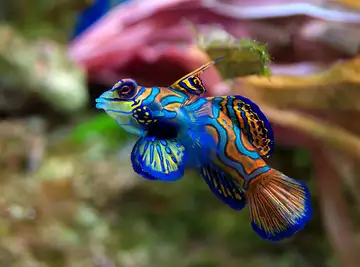
Which is longer: Mariana snailfish or Mandarinfish?
Show the answer
Mariana snailfish. (0.29 m vs 0.06 m) Mandarinfish →
More like this

Sources
Updated: 2026-10-14