
Bactrian camel
쌍봉낙타
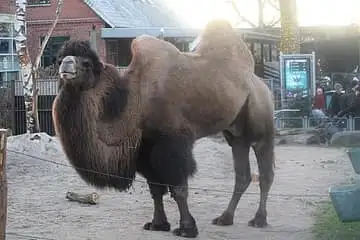
The two-humped Bactrian camel shrugs off both scorching summers and −40 °C winters in the Gobi Desert. Its humps store fat, not water, and when it finds a pond it can drink dozens of litres in a few minutes.
See it on the 3D globe →At a glance
- Class
- Mammals
- Lives in
- Gobi Desert, Mongolia
- Diet
- Plant eater (herbivore)
- Weight
- about 650 kg
- Length
- about 3.2 m
- Top speed
- about 65 km/h
- Lifespan
- up to about 50 years
- Habitat
- deserts, grasslands
Quick answers
Where does the Bactrian camel live?
It lives in deserts, grasslands. On the globe you can find it near Gobi Desert, Mongolia.
How big is the Bactrian camel?
It grows to about 3.2 m and 650 kg.
What does the Bactrian camel eat?
Its diet: plant eater (herbivore).
How fast is the Bactrian camel?
It can reach about 65 km/h.
How long does the Bactrian camel live?
It can live up to about 50 years.
The Bactrian camel is the two-humped camel of the steppes and deserts of Central Asia, including the Gobi in Mongolia. It is named after Bactria, an ancient region. About 2 million exist today, almost all of them domesticated. It is the largest living camel, although it stands lower at the shoulder than the one-humped dromedary.
For thousands of years people have used it as a pack animal in inner Asia, and it carried caravans along the Silk Road. Its two humps store fat, not water. Its legs are thick, its coat is long and shaggy, with a mane and beard on the neck, and its two broad toes spread wide to walk on sand. Long eyelashes and nostrils that can close help keep out dust in sandstorms.
Surviving extremes
The Bactrian camel copes with cold as low as about minus 30 degrees Celsius in winter and heat up to 50 in summer. It can go without water for months, but when it finds some it may drink up to 57 litres at once. When it is well fed its humps are plump and upright; when food runs short they shrink and flop to the side. It will even eat snow for water, and it can eat dry, thorny, salty or bitter plants that other animals avoid.
Domestic and wild
Domestic Bactrian camels (Camelus bactrianus) are a separate species from the wild Bactrian camel (Camelus ferus). The two split about 1 million years ago, so the domestic camel does not descend from the wild one. The wild camel is the only truly wild camelid in the Old World. Aristotle already described the one-humped and two-humped camels in the 4th century BCE. The two-humped and one-humped kinds can interbreed and have fertile young.
Growing up
Calves are born after a pregnancy of around 13 months, usually one at a time. Newborns open their eyes at birth, are covered in woolly fur and can run within a few hours. A camel is mature at about three to five years old. In the wild it may live up to about 50 years, though the average is around 30. In winter the shaggy coat is shed very quickly, with big sections peeling off at once, so the camel looks as if it has been sloppily shorn.
Fun facts
- Its two humps store fat, not water.
- It has two humps; the dromedary has one.
- Its humps store fat, not water.
- Calves can run a few hours after birth.
- It has been recorded running as fast as 65 km/h, though it rarely does.
On the globe
The model shows a camel with two humps on a thick, shaggy coat, as in the card. Look at the pair of humps.
Quiz time
Which is heavier: Bactrian camel or Pallas's cat?
Show the answer
Bactrian camel. (650 kg vs 3.5 kg) Pallas's cat →
More like this


.jpg)
Sources
Updated: 2026-10-14