
Gobi jerboa
고비날쥐
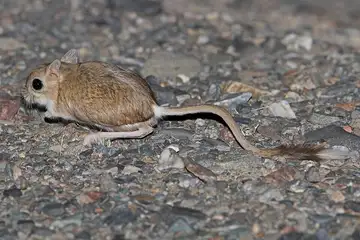
The northern three-toed jerboa is a mouse-sized desert rodent of Mongolia and China. It hops on long hind legs like a tiny kangaroo, balancing with a tail longer than its body that ends in a black-and-white tuft. It rests in burrows by day and forages at night.
See it on the 3D globe →At a glance
- Class
- Mammals
- Lives in
- Gobi Desert, Mongolia and China
- Diet
- Eats both plants and meat (omnivore)
- Conservation status
- Least Concern (IUCN LC)
- Habitat
- deserts
Quick answers
Where does the Gobi jerboa live?
It lives in deserts. On the globe you can find it near Gobi Desert, Mongolia and China.
What does the Gobi jerboa eat?
Its diet: eats both plants and meat (omnivore).
Is the Gobi jerboa endangered?
It is listed as Least Concern (IUCN LC).
The northern three-toed jerboa is a small desert rodent of Mongolia, northern China and a wide band of Central Asia, from near the Don River and the Caspian Sea to Iran, Uzbekistan and Kazakhstan. It is the only living species in the genus Dipus, and it is common, rated Least Concern by the IUCN. It lives in sandy deserts and semi-deserts and sometimes on sandy ground in pine forests.
Its head and body are 10 to 15.5 centimetres long and it weighs 56 to 117 grams. The long tail, 14.5 to 19 centimetres, ends in a black tassel with a white tip. Its upper side is ochre to reddish brown and the underside white. The back feet have just three toes, because three of the foot bones have fused into one.
How does it move?
It hops on two legs. Normal hops are only 10 to 15 centimetres long, but when alarmed it makes great bounds of 120 to 140 centimetres. The long hind feet have long white hairs on top and pads of stiff hairs under the toes. The tail helps with balance. Most of these jerboas are found between about 1,000 and 1,300 metres above sea level, but in the Altai Mountains they live as high as 3,000 metres. They live in sandy deserts, semi-deserts and sandy pastures.
Life underground
It is nocturnal and comes out after dark to look for seeds, but also grasses, shoots, leaves, bulbs, roots and insects. It lives alone or in pairs. Its main burrow can be 2.5 metres long and 1.5 metres deep, with a nest chamber and side rooms for storing food. It can dig about 40 centimetres in ten minutes. In the north of its range it hibernates underground from about November to March. It breeds in summer and has two or three litters, each with about three or four young.
Fun facts
- Jerboas hop on long back legs like tiny kangaroos, using their long tail for balance.
- A frightened jerboa can bound more than a metre in one leap.
- Its tail is longer than its body.
- It can dig about 40 centimetres of tunnel in ten minutes.
On the globe
The toy model of the Gobi jerboa hops across the Gobi Desert. Look for the long tail with a black-and-white tuft.
More like this

Sources
Updated: 2026-10-14