
Golden jellyfish
황금해파리
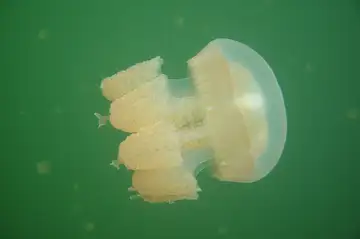
Golden jellyfish drift in huge swarms in the Jellyfish Lake of Palau. Algae living inside their bodies feed them with sunlight, so each day the swarm follows the sun across the lake. The bell is only about 6 to 10 cm wide and the sting is harmless to people.
See it on the 3D globe →At a glance
- Class
- Jellyfish & corals
- Lives in
- Jellyfish Lake, Palau
- Habitat
- coasts
Quick answers
Where does the Golden jellyfish live?
It lives in coasts of the Pacific Ocean. On the globe you can find it near Jellyfish Lake, Palau.
Golden jellyfish belong to the genus Mastigias, which has eight recognised species. They are found along coasts of the Indo-Pacific, from Australia to Japan and from Micronesia to the Indian Ocean. Many live in landlocked marine lakes, including the Jellyfish Lake of Palau. Our card says their bells are only about 6 to 10 centimetres wide and their sting is harmless to people.
The secret of the jellyfish is a partnership with tiny algae called zooxanthellae. The algae live inside the jellyfish's body and use sunlight to make food for it. Because of that, the jellyfish swim up to the sunny parts of the lake. Our card says millions cross Jellyfish Lake every day following the sun. The marine lake jellyfish swim more slowly than those in the open ocean.
How does the partnership work?
The algae live in cells of the jellyfish's gut lining. In return for a safe home, they feed their host. Researchers have found that one of these jellyfish makes its young, called ephyrae, only when its algae are present, so the algae are important for the whole life cycle. Mastigias jellyfish also reproduce by growing free-swimming buds. Marine lake jellyfish swim more slowly than their relatives in the ocean. Scientists have counted eight species in the genus.
Why are marine lakes special?
A marine lake is a body of seawater that is cut off from the open ocean, and the jellyfish inside have adapted to it. Warmer-than-usual water has been linked to fewer jellyfish and more deaths. The warming of the ocean is a concern for these lake populations. Some records of the jellyfish from Florida and Puerto Rico in the western Atlantic were most likely caused by people accidentally carrying them there. Their main home is the western and central Indo-Pacific, from Australia to Japan.
Fun facts
- Millions of them cross Jellyfish Lake every day following the sun, which feeds the algae inside them; their sting is too weak to feel.
- Golden jellyfish get food from algae living in their bodies.
- The Jellyfish Lake in Palau holds millions of them.
- Their sting is too weak for people to feel, according to our card.
On the globe
The toy model of the golden jellyfish drifts in the Jellyfish Lake of Palau. Look for the golden bell.
More like this

Sources
Updated: 2026-10-14