
Staghorn coral
녹각산호
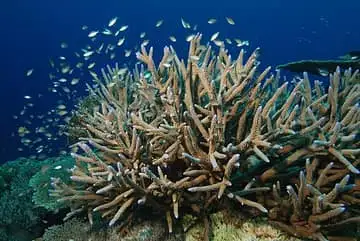
Staghorn coral branches like a stag's antlers and grows fast for a coral, around 10 to 20 cm a year. Algae live inside it, and countless small fish hide among its branches. When seas get too warm it bleaches white.
See it on the 3D globe →At a glance
- Class
- Jellyfish & corals
- Conservation status
- Critically Endangered (IUCN CR)
- Habitat
- coral reefs
Quick answers
Where does the Staghorn coral live?
It lives in coral reefs of the Atlantic Ocean.
Is the Staghorn coral endangered?
It is listed as Critically Endangered (IUCN CR).
Staghorn coral is a branching stony coral that looks like the antlers of a stag. Its thick, upright branches can grow taller than two metres. It lives in the western Atlantic Ocean, in the Caribbean, the Bahamas and around the Florida Keys, mostly in shallow reef waters less than 20 metres deep. Its colour comes from tiny algae living in its tissue and can be light brown, beige, green, blue or purple.
It grows fast for a coral, adding roughly 10 to 20 centimetres a year, which made it one of the main reef builders in the region. Fish hide among its branches, and reefs protect coastlines from storms. But since the late 1970s white-band disease and human pressures have wiped out most of it. It is listed as Critically Endangered.
A reef builder
Each staghorn colony is made of thousands of tiny animals called polyps. They make a hard skeleton of calcium carbonate that slowly builds the reef. Tiny algae live inside the coral and share food with it, which is why corals need clear, sunny water. The branches work as nurseries for young fish and as a buffer against waves.
Why it is in danger
Until the late 1970s, big stands of staghorn covered reefs in southern Florida and the Caribbean. White-band disease and other human-caused problems reduced the coral cover by more than 95 percent in some places. A marine heatwave in 2023 left it functionally extinct on Florida's reef. Scientists now grow fragments in nurseries and plant them back on reefs.
How it grows and spreads
Staghorn coral spreads in two ways. Most often a branch snaps off in a storm or when something disturbs the water, lands on a nearby surface and grows into a new colony. Each new colony is a clone of the original, so a whole reef can be genetically identical, which can make it easier for disease or heat to hit all of it at once. It can also reproduce with eggs and sperm, because every polyp makes both. Up to about 90 percent of its food comes from the algae inside it, and at night the polyps use stinging tentacles to catch drifting plankton.
Fun facts
- It can grow about 10–20 cm a year, which is fast for a coral.
- It can grow branches more than 2 metres tall.
- Fish use its branches like a nursery.
- White-band disease and other pressures wiped out more than 95 percent of the coral in some areas.
- Corals bleach when stressed by hot water and may die if the algae do not come back.
On the globe
On the toy globe the staghorn coral grows on a Caribbean-style reef. Look for the branches that look like deer antlers.
More like this

Sources
Updated: 2026-10-14