
Giant siphonophore
대형관해파리
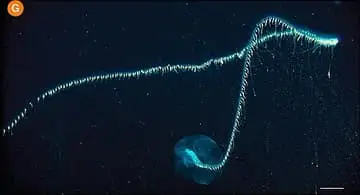
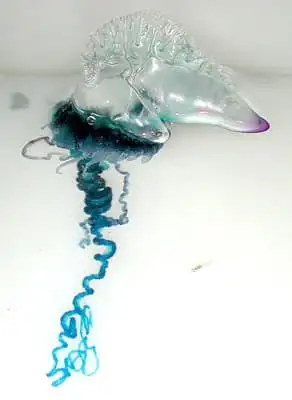
It looks like one animal but is really a colony of many tiny individuals, each with its own job, linked in a chain. Some species stretch tens of metres, among the longest animals ever found, trailing stinging tentacles in the deep.
See it on the 3D globe →At a glance
- Class
- Jellyfish & corals
- Diet
- Meat eater (carnivore)
- Habitat
- deep sea
Quick answers
Where does the Giant siphonophore live?
It lives in deep sea of the Pacific, Atlantic and Indian oceans.
What does the Giant siphonophore eat?
Its diet: meat eater (carnivore).
Praya dubia, the giant siphonophore, looks like one long, glassy ribbon drifting in the deep sea, but it is really a colony of tiny parts called zooids. Each zooid has its own job, and none can survive alone. It lives in the open ocean about 700 to 1,000 metres below the surface and has been found from Iceland to Chile.
Reports say it can reach 40 to 50 metres, which would put it among the longest sea animals and rival the blue whale, yet it is as thin as a broomstick. It is a drifting hunter that glows with blue light.
One animal made of many
Along its stalk, some zooids are powerful little jellyfish-like swimmers that pulse together to push the colony along, others are mouths and stomachs, and others are stinging tentacles for catching food. A gas-filled float at the front helps it hang in the water. The pieces work together like organs in a body.
Fragile and rarely seen
The body is held together by water pressure from the deep, so it bursts if it is brought to the surface. Fishing nets only drag up a blob of jelly, which is why scientists did not recognise it as a unique creature until the 19th century. In 1987, researchers at the Monterey Bay Aquarium Research Institute watched living animals in their natural habitat. Praya dubia is an active swimmer and lures prey with bright blue bioluminescent light.
Fun facts
- Some siphonophores, such as Praya dubia, can stretch over 40 m, rivalling the blue whale in length.
- It can be longer than a blue whale yet as thin as a broomstick.
- It bursts if brought up from the deep.
- It makes its own blue light to attract food.
- It appears in the BBC series Blue Planet II.
On the globe
The toy model shows a long, drifting siphonophore colony in the deep sea.
More like this
.jpg)
Sources
Updated: 2026-10-14