
Table coral
테이블산호
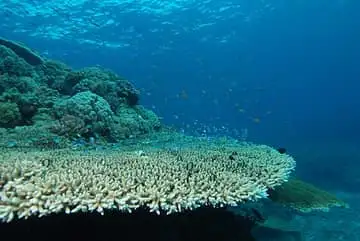
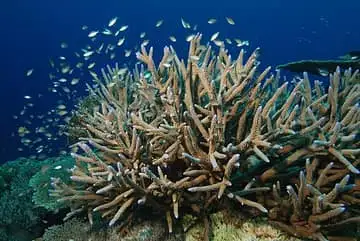
A coral that spreads out flat like a table, built by a colony of tiny polyps. It lives in partnership with algae inside its tissue, and large colonies can be several metres across, giving fish shade and shelter.
See it on the 3D globe →At a glance
- Class
- Jellyfish & corals
- Habitat
- coral reefs
Quick answers
Where does the Table coral live?
It lives in coral reefs of the Pacific and Indian oceans.
Table coral is the nickname of some species of Acropora, a group of stony corals that build reefs. Table-shaped ones spread out flat like a tabletop, and large colonies can be several metres across. Each colony is made of thousands of tiny animals called polyps, about 2 millimetres wide, which share tissue and a simple nerve net.
Acropora is the biggest group of reef-building corals, with more than 149 described species. More than 100 live in the Indo-Pacific and three in the Caribbean. Their hard skeletons form the framework that supports the thin living skin of a reef. Fish and many other animals find shade and shelter beneath the flat tables. Most are brown or green, and the polyps stretch out further at night to catch plankton.
Partners inside
Tiny algae called zooxanthellae live in the coral's cells and make food from sunlight for the polyps. A flat shape catches a lot of light for those algae. The polyps usually stretch out further at night to catch plankton. Colonies can grow quickly, and in the wild some exceed a metre in size.
Bleaching
When the water gets too warm or too dirty, corals push out their algae and turn stark white, called bleaching. Without their algae partners they can starve and die. Acropora is especially sensitive. Pollution, ocean acidification and sediment also hurt them. In 2014 the United States listed ten Acropora species as threatened. Aquarium keepers grow fragments, and some are used to restore damaged reefs.
Growing coral at home and on reefs
Most Acropora species are brown or green, but a few are brightly coloured, and these rare ones are prized by people who keep reef aquariums. Many Acropora grow quickly when conditions are right. A finger-sized fragment in a well-kept tank can grow into a colony the size of a medicine ball in one to two years. They are hard to keep, though: they need bright light, steady temperatures, extra calcium and clean, rushing water. Fragments from captive colonies are sometimes planted on bare reefs in the wild to help them recover.
Fun facts
- Its flat, table-like shape catches plenty of sunlight for the algae living inside it.
- Acropora contains over 149 described species.
- Its tiny polyps are only about 2 millimetres across.
- The flat table shape gives shade and shelter to fish.
- Bleached corals are stark white and may die if their algae do not return.
On the globe
On the toy globe the table coral spreads out on a tropical reef in the Indo-Pacific. Look for the flat, tabletop shape.
More like this

Sources
Updated: 2026-10-14