
Golden lion tamarin
황금사자타마린
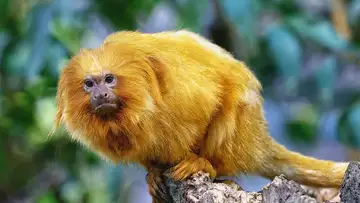
The golden lion tamarin is a small monkey with a glowing golden coat and a lion-like mane, found only in the Atlantic Forest of Brazil. Habitat loss once pushed it near extinction, but conservation has helped it recover.
See it on the 3D globe →At a glance
- Class
- Mammals
- Lives in
- Atlantic Forest of coastal Brazil
- Diet
- Eats both plants and meat (omnivore)
- Weight
- about 0.62 kg
- Length
- about 0.6 m
- Conservation status
- Endangered (IUCN EN)
- Habitat
- rainforests
Quick answers
Where does the Golden lion tamarin live?
It lives in rainforests. On the globe you can find it near Atlantic Forest of coastal Brazil.
How big is the Golden lion tamarin?
It grows to about 0.6 m and 0.62 kg.
What does the Golden lion tamarin eat?
Its diet: eats both plants and meat (omnivore).
Is the Golden lion tamarin endangered?
It is listed as Endangered (IUCN EN).
The golden lion tamarin, Leontopithecus rosalia, is a small New World monkey with a glowing reddish-orange coat and extra-long hair around the face and ears that forms a lion-like mane. Its face is dark and hairless. It is the largest of the callitrichid monkeys, the family of tamarins and marmosets, yet it is only about 26 centimetres long and weighs around 620 grams, and males and females are almost the same size.
It lives only in the Atlantic coastal forests of Brazil, entirely inside the state of Rio de Janeiro. The species is Endangered. A 2022 and 2023 census estimated about 4,800 wild animals in its main area. Its bright orange fur does not contain carotenoids, the pigments that make most orange colours in nature. Its Portuguese name is mico-leao-dourado.
Eating and moving
Golden lion tamarins eat mostly ripe fruit and small animals, plus some nectar and tree gum. They swallow most seeds, so they help spread many kinds of plants. In one study they ate 160 plant species. Their animal food includes frogs, lizards, spiders, insects and bird eggs.
They find hidden prey by poking their fingers, hands and even forearms into crevices, bromeliads and rolled leaves and feeling their way. They walk, run and bound along the tops of branches, and their claw-like nails help them climb straight tree trunks.
Family groups
Groups hold two to eight animals, usually one breeding pair and their young. Only the dominant female breeds. Females have mostly twins after a four-month pregnancy, and everyone in the group helps carry and raise the babies. In 2001 at Poco das Antas, 78 percent of births were twins.
The infants depend fully on their mother for four weeks, begin exploring around week five, become juveniles at 17 weeks, and become subadults at 14 months. Most new recruits to groups are males, and young animals can leave their birth group at about age four.
From 100 to thousands
Most of the original forest in Rio de Janeiro has been cleared, and the tamarins now live in forest fragments, such as the Poco das Antas and Uniao Biological Reserves and on private land. In the 1960s and 1970s there were only about 100 to 600 left.
The first census in 1990 to 1992 counted about 560 in the wild plus 100 released animals. Then zoo-born tamarins were reintroduced, wild ones were rescued, forests were replanted and joined up, and communities took part. The population grew to over 4,800, and the Golden Lion Tamarin Association keeps working on remaining threats.
Fun facts
- Its bright orange fur does not use carotenoids, the usual orange pigments.
- About 78 percent of births in one reserve in 2001 were twins.
- Only the dominant female in a group breeds.
- The wild population was only 100 to 600 in the 1970s, and now exceeds 4,800.
On the globe
The model shows a golden lion tamarin with its glowing coat and lion-like mane in the Atlantic Forest of Brazil.
Quiz time
Which is heavier: Golden lion tamarin or Maned wolf?
Show the answer
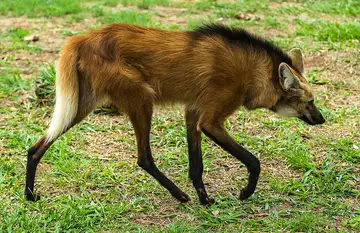
Maned wolf. (0.62 kg vs 23 kg) Maned wolf →
More like this
.jpg)
Sources
Updated: 2026-10-14