
Maned wolf
갈기늑대
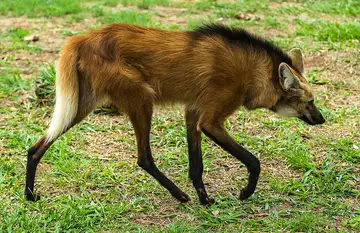
The maned wolf is South America's largest canid. Its stilt-like legs let it see over tall grass, and it has a fox-red coat with a black mane. It eats small animals and a lot of fruit.
See it on the 3D globe →At a glance
- Class
- Mammals
- Lives in
- Cerrado grasslands of Brazil and Bolivia
- Diet
- Eats both plants and meat (omnivore)
- Weight
- about 23 kg
- Length
- about 1.4 m
- Conservation status
- Near Threatened (IUCN NT)
- Habitat
- grasslands, savannas
Quick answers
Where does the Maned wolf live?
It lives in grasslands, savannas. On the globe you can find it near Cerrado grasslands of Brazil and Bolivia.
How big is the Maned wolf?
It grows to about 1.4 m and 23 kg.
What does the Maned wolf eat?
Its diet: eats both plants and meat (omnivore).
Is the Maned wolf endangered?
It is listed as Near Threatened (IUCN NT).
The maned wolf, Chrysocyon brachyurus, is the largest canine in South America. It weighs 20 to 30 kilograms and stands up to 110 centimetres at the shoulder. Its coat is reddish like a fox, but it is neither a fox nor a wolf. It belongs to its own genus, whose name means golden dog, and it is not closely related to foxes, wolves, coyotes or jackals. Its long, slender legs help it see over tall grass.
It lives in open and semi-open habitats such as grasslands with scattered bushes, in the Cerrado of Brazil, Paraguay, northern Argentina, Bolivia and a corner of Peru. It is almost gone from Uruguay. The IUCN lists it as Near Threatened. It is a solitary animal that talks mainly by scent marks, and also gives a loud call known as a roar-bark.
What it eats
The maned wolf is an omnivore. It hunts small and medium animals such as rodents, rabbits, birds and their eggs, reptiles, fish and insects, but most of its diet is plants, including fruit, sugarcane, tubers and roots. Up to 301 food items have been recorded, 116 plants and 178 animals.
Its favourite is the wolf apple, a tomato-like fruit that makes up 40 to 90 percent of the diet, eaten throughout the year. The seeds pass through unharmed, so the wolf spreads the plant.
Hunting alone
Unlike most large canids, the maned wolf lives and hunts alone rather than in a pack. It hunts mostly between sundown and midnight, turning its large ears to listen for animals in the grass. It taps the ground with a front foot to flush out prey, and then pounces. About 21 percent of hunts succeed.
Pairs may share a territory of about 30 square kilometres, although they rarely meet outside the mating season. The territory is crisscrossed by paths that they make while patrolling at night.
Pups and people
The mating season runs from November to April, and pregnancy lasts 60 to 65 days. A litter has two to six black-furred pups of about 450 grams each. Pups are fully grown at one year old, and rely on their parents for food in that first year.
Attitudes vary. In parts of Brazil some people believe body parts of the animal cure illness or bring luck, and in Bolivia a saddle of its leather is thought to ward off bad luck. Its main threats are deforestation, roadkill and growing cities. In 2011 a maned wolf hit by a truck at Zoo Brasilia got stem cell treatment, the first recorded use in a wild animal.
Fun facts
- Up to half of what it eats is fruit, especially the 'wolf apple'.
- The wolf apple makes up 40 to 90 percent of its diet.
- It taps the ground with a front paw to scare out hidden prey.
- Its genus name Chrysocyon means golden dog.
- In 2011 a maned wolf in Brazil became the first wild animal recorded to get stem cell treatment.
On the globe
The model shows a maned wolf with long stilt-like legs and a black mane in the South American grassland.
Quiz time
Which is heavier: Maned wolf or Golden lion tamarin?
Show the answer
Maned wolf. (23 kg vs 0.62 kg) Golden lion tamarin →
More like this


Sources
Updated: 2026-10-14