
Giant armadillo
큰아르마딜로
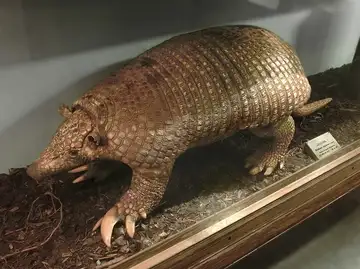
The giant armadillo is the largest living armadillo, nearly a metre long. Its front feet carry sickle-shaped claws over 15 cm long for digging burrows and breaking into termite mounds, mostly at night.
See it on the 3D globe →At a glance
- Class
- Mammals
- Lives in
- Amazon, Cerrado and Pantanal of South America
- Diet
- Insect eater
- Weight
- about 25 kg
- Length
- about 1.4 m
- Conservation status
- Vulnerable (IUCN VU)
- Habitat
- rainforests, grasslands, savannas
Quick answers
Where does the Giant armadillo live?
It lives in rainforests, grasslands, savannas. On the globe you can find it near Amazon, Cerrado and Pantanal of South America.
How big is the Giant armadillo?
It grows to about 1.4 m and 25 kg.
What does the Giant armadillo eat?
Its diet: insect eater.
Is the Giant armadillo endangered?
It is listed as Vulnerable (IUCN VU).
The giant armadillo is the largest living armadillo. It lives in northern and central South America east of the Andes, as far south as northern Argentina. A typical adult is 75 to 100 centimetres long, with a tail adding about 50 centimetres more, and weighs about 19 to 32 kilograms. It is considered vulnerable to extinction.
Its body has 11 to 13 hinged bands of armour, and its head and tail are covered with scales. It is almost hairless, with just a few beige hairs between the scutes. The huge front claws are the real tools. They are sickle-shaped, and the longest, on the third finger, can reach about 22 centimetres, the proportionally largest claws of any living mammal.
How does it eat?
The giant armadillo mostly eats termites and some ants, and it often finishes off the whole population of a termite mound. It also takes worms, larvae, spiders, snakes and some plants, and some have dug into beehives to eat bees. It uses the claws to rip open mounds. It has 80 to 100 teeth, more than any other land mammal, but they are simple, lack enamel and keep growing for life.
Where does it live?
It mostly lives in open places. Cerrado grassland covers about a quarter of its range, but it also lives in lowland forests. Giant armadillos are solitary and active at night, and they spend the day in burrows. Their burrows are unusually large, with entrances about 43 centimetres wide that often face west. They cannot roll into a full ball, so they dig to escape from predators.
Fun facts
- The middle claw on each front foot can be about 20 cm long, the largest claw of any living mammal.
- Its 80 to 100 teeth are more than any other land mammal has.
- Its sickle-shaped claws can be about 22 centimetres long.
- It often eats up the whole population of a termite mound.
On the globe
The toy model of the giant armadillo walks in the Amazon, Cerrado and Pantanal region. Look for the banded armour and the big front claws.
Quiz time
Which is heavier: Giant armadillo or Jaguar?
Show the answer
Jaguar. (25 kg vs 76 kg) Jaguar →
More like this
_at_G%C3%B6teborgs_Naturhistoriska_Museum_(8918).jpg)
Sources
Updated: 2026-10-14