
Giant otter
큰수달
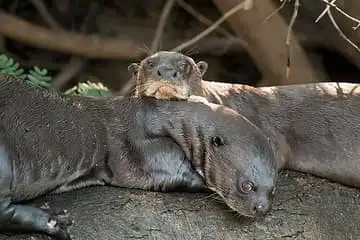
The giant otter is the longest otter in the world at up to 1.8 m. Family groups of around ten hunt fish together in South American rivers, calling to each other with a range of whistles and barks.
See it on the 3D globe →At a glance
- Class
- Mammals
- Lives in
- Xingu River, Brazil
- Diet
- Fish eater
- Weight
- about 27 kg
- Length
- about 1.6 m
- Conservation status
- Endangered (IUCN EN)
- Habitat
- rivers & lakes, wetlands, rainforests
Quick answers
Where does the Giant otter live?
It lives in rivers & lakes, wetlands, rainforests. On the globe you can find it near Xingu River, Brazil.
How big is the Giant otter?
It grows to about 1.6 m and 27 kg.
What does the Giant otter eat?
Its diet: fish eater.
Is the Giant otter endangered?
It is listed as Endangered (IUCN EN).
The giant otter is a South American river mammal and the longest member of the weasel family, reaching up to 1.8 metres. Unlike most weasels, it is very social. A family group usually has three to eight members and is built around a breeding pair. They cooperate closely, but they also defend their territory from other groups.
It is active only in the daytime and is the noisiest of the otters, with distinct calls for alarm, aggression and reassurance. Giant otters live mostly in and along the Amazon River and in the Pantanal. Hunting for their velvety fur, which peaked in the 1950s and 1960s, greatly reduced their numbers. The species was listed as endangered in 1999, and fewer than 5,000 are thought to live in the wild.
How is it built for water?
It has exceptionally dense fur, a wing-like tail and webbed feet. It prefers freshwater rivers and streams that flood seasonally, and it builds large campsites near its feeding places, clearing a lot of plants. It eats almost only fish, especially characins and catfish, and sometimes crabs, turtles, snakes and small caimans. It has few enemies except people, but it competes for food with other predators.
Names and dangers
In Brazil it is called ariranha, from a Tupi word, or onça-d'água, 'water jaguar'. In Spanish it is sometimes called river wolf. The Guianas are one of the last real strongholds of the species, and it is also protected in Peru. The greatest threat today is habitat loss and damage. Giant otters are also rare in captivity: in 2003 only 60 were held in zoos.
Fun facts
- Giant otter families live and hunt together, keeping in touch with whistles, barks and screams.
- It is the noisiest of all otters.
- In Brazil it is nicknamed the 'water jaguar'.
- Families keep in touch with whistles, barks and screams.
On the globe
The toy model of the giant otter swims in the Xingu River basin, Brazil. Look for its flat tail and webbed feet.
Quiz time
Which is heavier: Giant otter or South American tapir?
Show the answer
South American tapir. (27 kg vs 225 kg) South American tapir →
More like this
.jpg)
Sources
Updated: 2026-10-14