
Giant anteater
큰개미핥기
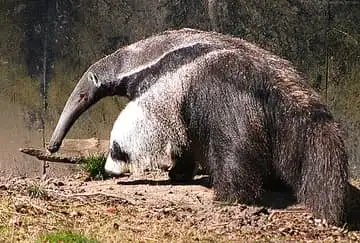
It has no teeth but uses a 60 cm tongue to eat up to 30,000 ants and termites a day. The tongue flicks in and out about 150 times a minute, and the anteater sleeps much of the day under its bushy tail like a blanket.
See it on the 3D globe →At a glance
- Class
- Mammals
- Lives in
- Emas National Park, Brazil
- Diet
- Insect eater
- Weight
- about 33 kg
- Length
- about 2 m
- Lifespan
- up to about 25 years
- Conservation status
- Vulnerable (IUCN VU)
- Habitat
- grasslands, savannas, forests
Quick answers
Where does the Giant anteater live?
It lives in grasslands, savannas, forests. On the globe you can find it near Emas National Park, Brazil.
How big is the Giant anteater?
It grows to about 2 m and 33 kg.
What does the Giant anteater eat?
Its diet: insect eater.
How long does the Giant anteater live?
It can live up to about 25 years.
Is the Giant anteater endangered?
It is listed as Vulnerable (IUCN VU).
The giant anteater is a large, toothless mammal of Central and South America. It is the biggest of the four living anteaters and the only member of its genus. You can spot it by its long tube-shaped snout, bushy tail, long front claws and striking fur. Unlike its relatives and the sloths, which live in trees, the giant anteater spends most of its time on the ground.
It eats mainly ants and termites. It digs them out with its front claws and collects them with a sticky tongue that is about 60 cm long. The card says it can eat as many as 30,000 insects a day. It is listed as vulnerable, and in many places where it once lived it has disappeared.
Eating without teeth
The giant anteater has no teeth. Its tongue is very long but only about 12.5 mm wide, and it flicks in and out around 150 times a minute. Its eyesight and hearing are weak, but its sense of smell is excellent, and that is how it finds nests. It lives in several habitats, from grassland to rainforest, foraging in open areas and resting in more wooded places.
Mothers and babies
Giant anteaters live on overlapping ranges but are mostly solitary. They meet to mate, when males fight, and when a mother is raising her young. A mother carries her baby on her back until it is weaned. Its bushy tail also works as a blanket while it sleeps.
Fun facts
- It has no teeth and can eat about 30,000 ants and termites in a day.
- It has no teeth at all.
- Its tongue is about 60 cm long but only 12.5 mm wide.
- Mothers carry their babies on their backs.
- It can reach about 2 metres in length, and up to 65 kg in weight.
On the globe
The model shows the long snout and big bushy tail described on the card. Try to spot where the tail curls over the back.
Quiz time
Which is heavier: Giant anteater or Jaguar?
Show the answer
Jaguar. (33 kg vs 76 kg) Jaguar →
More like this

Sources
Updated: 2026-10-14