
Goliath grouper
골리앗그루퍼
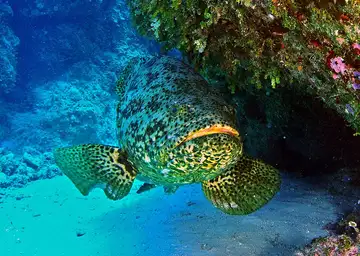
The goliath grouper is a huge fish of reefs, wrecks and mangroves along tropical Atlantic coasts. It has a mottled brown-yellow body, a broad head and a wide mouth that sucks prey in whole. It can reach about 2.5 m and 360 kg.
See it on the 3D globe →At a glance
- Class
- Fish
- Lives in
- Reefs, wrecks and mangroves of the tropical Atlantic, here the Florida Keys
- Diet
- Meat eater (carnivore)
- Lifespan
- up to about 37 years
- Conservation status
- Vulnerable (IUCN VU)
- Habitat
- coral reefs, coasts
Quick answers
Where does the Goliath grouper live?
It lives in coral reefs, coasts of the Atlantic Ocean. On the globe you can find it near Reefs, wrecks and mangroves of the tropical Atlantic, here the Florida Keys.
What does the Goliath grouper eat?
Its diet: meat eater (carnivore).
How long does the Goliath grouper live?
It can live up to about 37 years.
Is the Goliath grouper endangered?
It is listed as Vulnerable (IUCN VU).
The goliath grouper is one of the largest bony fish in the sea. This page uses the Atlantic goliath grouper, Epinephelus itajara, which lives in the West Atlantic from northeastern Florida through the Gulf of Mexico and Caribbean to Brazil, and in West Africa and the East Pacific. It has been seen at depths from 1 to 100 metres. A Pacific and an Indo-Pacific species share the same common name.
It can reach about 2.5 metres and 363 kilograms. Its colour ranges from brownish yellow to grey or greenish, with small black dots on head, body and fins. Young fish under 1 metre have three or four faint bars on their sides. It has a long body, a broad flat head and small eyes. Adults stay around rocky reefs, wrecks and artificial reefs.
What does it eat?
It usually hunts slow-moving fish such as stingrays, catfish and toadfish and also crustaceans. It rarely takes snappers or other groupers. It might also take an octopus or a young sea turtle by accident. Its mouth is wide, and its lower jaw has three to five rows of teeth but no front fangs. Our card says that it can make a booming sound to warn off divers and other fish.
The history of its name
For a long time the fish was called 'jewfish'. A 1996 review of the word concluded that the fish's looks were often linked to anti-Jewish stereotypes. After complaints, the name was changed: the New York Aquarium used 'Junefish' in 1927, and in 2001 the American Fisheries Society changed it to goliath grouper. The oldest fossils of the species are from the Late Miocene of Venezuela.
Fun facts
- It can make a loud booming sound with its swim bladder to warn off divers and other fish.
- It can grow up to about 2.5 metres long.
- It was once called 'jewfish', a name changed in 2001.
- It can make loud booming sounds, according to our card.
On the globe
The toy model of the goliath grouper lies near a reef or wreck in the Florida Keys. Look for the huge body and the broad head.
More like this

Sources
Updated: 2026-10-14