
Southern stingray
남방가오리
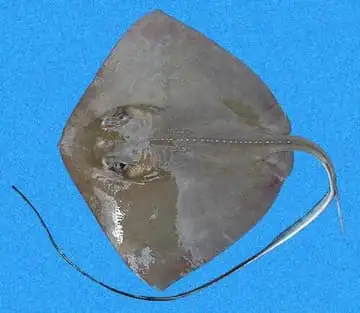
A ray of shallow sandy Caribbean seabeds that rests half-buried in sand, with a flat body about 1.5 m wide. The barb on its tail is for defence, and it digs up clams and shrimp to eat.
See it on the 3D globe →At a glance
- Class
- Fish
- Diet
- Meat eater (carnivore)
- Lifespan
- up to about 28 years
- Habitat
- coasts
Quick answers
Where does the Southern stingray live?
It lives in coasts of the Atlantic Ocean.
What does the Southern stingray eat?
Its diet: meat eater (carnivore).
How long does the Southern stingray live?
It can live up to about 28 years.
The southern stingray is a flat, diamond-shaped ray that lives in warm shallow waters of the western Atlantic Ocean, from New Jersey down to southern Brazil. Its back is mud brown, olive or grey, and its belly is white. Females can reach about 1.5 metres across the body disc, while males stay under about 70 centimetres. It can reach population densities of up to about 245 per square kilometre in some shallow nursery areas.
It often rests on sandy sea floors with its body half buried, so only its eyes and small breathing holes show. Its long tail carries a serrated, venomous spine. The spine is used only for defence, and it is not usually fatal to humans but it is painful if stepped on.
Life on the sand
The stingray's eyes sit on top of its head, and a pair of openings called spiracles lets it take in water for breathing even while it is half buried. It swims by sending wave-like ripples along its wide pectoral fins. At night it hunts for small fish, worms, crustaceans and clams, flapping its fins or squirting water to uncover hidden prey.
Staying safe
Southern stingrays are usually calm, and they use their tail spine only when threatened. People wading in shallow water are advised to shuffle their feet along the sand so the rays can swim away first. In some places the rays gather in large numbers in shallow nursery areas, where up to 245 may live in each square kilometre.
Babies and divers
Southern stingrays give birth to live young. The eggs develop inside the mother, and after about seven to eight months a litter of two to ten pups is born, with no parental care afterwards. In the Caribbean, places such as Stingray City in the Cayman Islands and Gibbs Cay in Turks and Caicos let visitors swim with the rays and feed them by hand. Some rays have grown so used to visitors that people compare them to well-fed pet dogs, although scientists worry about the effect of this feeding.
Fun facts
- It often lies buried in sand with only its eyes showing, and uses its venomous tail spine only for defence.
- Its eyes are on top of its head, so it can see while buried in sand.
- Female rays are much bigger than males.
- It breathes through spiracles behind the eyes when half buried.
- In some shallow nursery grounds up to 245 rays share a square kilometre.
- Stingray pups are born alive, in litters of about two to ten.
On the globe
On the toy globe the southern stingray rests on a sandy seabed in the Caribbean. Look for the flat diamond-shaped body and long tail.
More like this

Sources
Updated: 2026-10-14