
Nurse shark
넙치상어
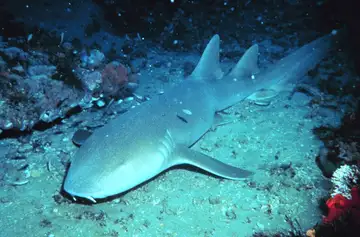
The nurse shark is a sluggish shark of shallow reefs and sandy flats in the Atlantic and eastern Pacific. It is tan with whisker-like barbels by the mouth, and rests in groups under ledges by day. It hunts at night by sucking in prey, and grows 2.5 to 3 m.
See it on the 3D globe →At a glance
- Class
- Fish
- Lives in
- Shallow reefs and sandy flats of the Atlantic, here off Belize
- Diet
- Meat eater (carnivore)
- Length
- about 2.5 m
- Conservation status
- Vulnerable (IUCN VU)
- Habitat
- coral reefs, coasts
Quick answers
Where does the Nurse shark live?
It lives in coral reefs, coasts of the Atlantic and Pacific oceans. On the globe you can find it near Shallow reefs and sandy flats of the Atlantic, here off Belize.
How big is the Nurse shark?
It grows to about 2.5 m.
What does the Nurse shark eat?
Its diet: meat eater (carnivore).
Is the Nurse shark endangered?
It is listed as Vulnerable (IUCN VU).
The nurse shark (Ginglymostoma cirratum) is a slow, bottom-living shark of tropical and subtropical coastal waters. It lives along the Eastern and Western Atlantic, from Cape Verde to Gabon and from Rhode Island to southern Brazil, and in the Eastern Pacific from Baja California to Peru. It is brownish, with two rounded dorsal fins, rounded pectoral fins and a broad head.
The IUCN assesses it as vulnerable worldwide. It is considered least concern in the United States and The Bahamas, but near threatened in the western Atlantic because of its status in South America and threats in Central America and the Caribbean. It is robust and handles capture and tagging very well, which makes it an important species for shark research.
Day sleeper, night hunter
Young nurse sharks stay on the bottom of shallow coral reefs, seagrass flats and mangrove islands, while older ones live around deeper reefs and rocks. By day they shelter in crevices and under ledges, often in large resting groups. At night they leave to feed on the seabed in shallower water, usually alone.
They are opportunistic predators of small fish such as stingrays, plus crustaceans, molluscs, sea urchins and algae. Nurse sharks are suction feeders, with some of the strongest suction forces recorded for any water vertebrate. Their mouth is small, but it can pull prey out of crevices.
Why is it called nurse?
Nobody knows for sure. The Oxford English Dictionary notes that in medieval times the n of the word an often slid onto the next word, and huss, husse and hurse were old names for dogfish and other sharks. Another idea is that the name relates to the way the shark gives birth to live young.
The scientific name Ginglymostoma comes from Greek words meaning hinged mouth, and cirratum from Latin, meaning having curled ringlets, for the barbels near the mouth.
Pups and homebodies
Nurse sharks are ovoviviparous, meaning the eggs hatch inside the mother. Mating season runs from late June to the end of July, the pregnancy lasts about six months, and a typical litter is 21 to 29 pups. Newborns are about 30 centimetres long with spots that fade with age.
Unlike most sharks, nurse sharks are very sedentary. They stay near the same reefs and even return to the same mating sites again and again. American alligators and crocodiles sometimes eat them in coastal waters. The largest adult length documented is 3.08 metres.
Fun facts
- It sucks prey out of crevices like a vacuum cleaner and often rests in piles on the seabed by day.
- The genus name means hinged mouth, and the species name means with curled ringlets.
- Nurse sharks tolerate tagging well, so they are studied a lot.
- Some fisheries target them directly.
- Newborn nurse sharks are about 30 cm long and have spots.
On the globe
The model shows a tan nurse shark with barbels near its mouth, resting by the seabed.
Quiz time
Which is longer: Nurse shark or Great barracuda?
Show the answer
Nurse shark. (2.5 m vs 0.8 m) Great barracuda →
More like this

Sources
Updated: 2026-10-14