
Vulturine guineafowl
독수리뿔닭
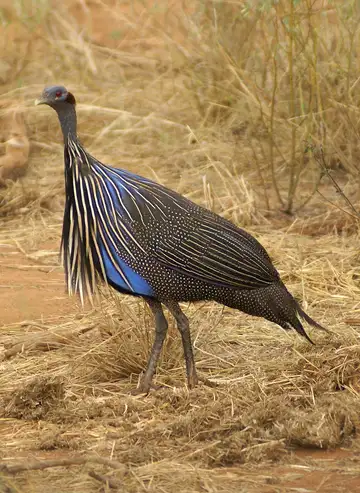
A guineafowl with a cobalt-blue breast, long white-striped hackles and a bald blue head. It walks in flocks of twenty or more through dry bushland, eating seeds and insects.
See it on the 3D globe →At a glance
- Class
- Birds
- Lives in
- Dry savanna of Kenya, Ethiopia and Somalia
- Diet
- Eats both plants and meat (omnivore)
- Weight
- about 1.3 kg
- Length
- about 0.66 m
- Conservation status
- Least Concern (IUCN LC)
- Habitat
- savannas
Quick answers
Where does the Vulturine guineafowl live?
It lives in savannas. On the globe you can find it near Dry savanna of Kenya, Ethiopia and Somalia.
How big is the Vulturine guineafowl?
It grows to about 0.66 m and 1.3 kg.
What does the Vulturine guineafowl eat?
Its diet: eats both plants and meat (omnivore).
Is the Vulturine guineafowl endangered?
It is listed as Least Concern (IUCN LC).
The vulturine guineafowl, Acryllium vulturinum, is the largest guineafowl in the world. It is about 61 to 71 centimetres long and weighs around one to one and a half kilograms. A bare blue face and long neck make it look a bit like a vulture, and a cape of long blue and white feathers drapes over its shoulders.
It lives in dry, open bushland and grassland in north-eastern Africa, from southern Ethiopia and Somalia through Kenya to northern Tanzania. Its breast is a bright cobalt blue and the rest of its body is black with fine white spots. It is a social bird, and its looks make it one of the most striking birds of the African savanna.
What do they eat and how do they move?
They eat seeds, roots, tubers, grubs, insects, and sometimes small reptiles and rodents. They walk on the ground in flocks of about 25 birds, running rather than flying when alarmed, and sleep in trees at night.
They make loud, repeated 'chink' calls. A nest is just a well-hidden scrape lined with grass, with four to eight cream eggs. They are also seen in the wild with grazing animals, sticking close to cover even in open ground.
A bird society like monkeys?
Scientists studying these birds found that small flocks join together into larger groups, and those into even bigger ones, forming a layered society. Such multi-level groups were once thought to exist mainly in mammals such as primates.
Which flocks belong together seems to be stable over time, so each bird lives in a tight community. Young birds are mostly grey-brown with a duller blue breast and short hackles.
Fun facts
- Its flocks join into larger groups, forming a layered society once thought to exist only in mammals such as primates.
- It is the biggest guineafowl.
- Small flocks join into larger groups, a layered society similar to some primates.
- It looks like a vulture because of its bare neck and head, but it is a ground-living bird.
On the globe
The model shows a cobalt-blue-breasted guineafowl with a bald blue head and white-striped neck feathers.
Quiz time
Which is heavier: Vulturine guineafowl or Grey crowned crane?
Show the answer
Grey crowned crane. (1.3 kg vs 3.5 kg) Grey crowned crane →
More like this

Sources
Updated: 2026-10-14