
Humpback whale
혹등고래
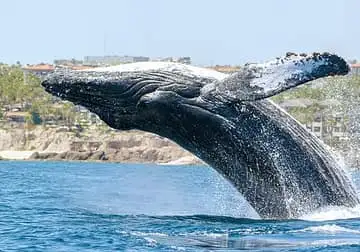
A whale with very long white flippers, famous for spectacular breaches and complex songs. It grows to about 15 m, and the males' songs keep changing, with whole populations picking up the new versions.
See it on the 3D globe →At a glance
- Class
- Mammals
- Lives in
- North Pacific, north of Hawaii
- Diet
- Filter feeder
- Weight
- about 30,000 kg
- Length
- about 14 m
- Top speed
- about 27 km/h
- Lifespan
- up to about 90 years
- Conservation status
- Least Concern (IUCN LC)
- Habitat
- open ocean, coasts
Quick answers
Where does the Humpback whale live?
It lives in open ocean, coasts of the Pacific, Atlantic, Indian and Southern oceans. On the globe you can find it near North Pacific, north of Hawaii.
How big is the Humpback whale?
It grows to about 14 m and 30,000 kg.
What does the Humpback whale eat?
Its diet: filter feeder.
How fast is the Humpback whale?
It can reach about 27 km/h.
How long does the Humpback whale live?
It can live up to about 90 years.
Is the Humpback whale endangered?
It is listed as Least Concern (IUCN LC).
The humpback whale, Megaptera novaeangliae, is a baleen whale found in oceans around the world. It is a rorqual, in the same family as the blue, fin and minke whales. Adults are usually 14 to 17 metres long and weigh up to about 40 tonnes, and females are a little longer than males. It is loved by whale watchers for breaching, leaping out of the water, and for slapping the surface with its tail and flippers.
Humpbacks usually migrate between cold feeding areas near the poles and warm breeding areas near the equator. Some travel up to about 16,000 kilometres a year between Alaska and Hawaii. They mostly eat krill and small fish, and often trap them with bubbles. Males sing complex songs that usually last 4 to 33 minutes.
Songs and bubbles
Only males sing, and the song is a long, complex pattern of sounds. The humpback's vocal folds lie more horizontally than those of land mammals, which helps it make calls underwater, and a throat sac amplifies them. The songs keep changing, and whole populations pick up the new versions.
To feed, humpbacks blow bubbles to trap prey, a clever hunting method. They are slower swimmers than other rorquals, cruising at about 8 to 15 km/h, but a threatened whale can speed up to about 27 km/h. Orcas are their main natural predators.
Flippers, bumps and names
The flippers are about a third of the body length, the longest of any whale. Humpbacks are unique among large whales in having bumps, called tubercles, on the head and the front edge of the flippers. They are rich in nerves and may help the whale sense its surroundings. The jagged edge of the tail fluke and its black-and-white pattern help scientists tell individual whales apart.
The common name comes from the curve of the back when the whale dives. The genus name Megaptera means giant wing, and the species name means New Englander, perhaps because they were often seen off New England. A calf is born about 4.3 metres long and weighing around 680 kg.
From near extinction to recovery
Like other large whales, humpbacks were hunted by the whaling industry, and by the 1960s only around 5,000 were left. Since then protection has helped numbers recover to about 135,000 worldwide.
They are still harmed by entanglement in fishing gear, collisions with ships and noise in the ocean. Genetic studies suggest modern humpbacks began in the southern hemisphere about 880,000 years ago and spread north much later. A group in the Arabian Sea does not migrate and has been isolated for about 70,000 years.
Fun facts
- Male humpbacks sing long, complex songs that slowly change from year to year.
- Its flippers are the longest of any whale, about a third of its body length.
- A male's song can last from 4 to 33 minutes.
- A rare all-white humpback called Migaloo is a true albino.
- By the 1960s only about 5,000 humpbacks were left, and now there are around 135,000.
On the globe
Find it in the North Pacific north of Hawaii; the card points out its long white flippers.
Quiz time
Which is heavier: Humpback whale or Hawaiian monk seal?
Show the answer
Humpback whale. (30,000 kg vs 200 kg) Hawaiian monk seal →
More like this


Sources
Updated: 2026-10-14