
Humphead (Napoleon) wrasse
나폴레옹피시
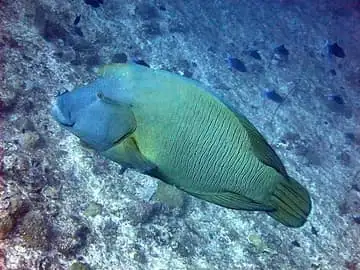
A giant reef fish with a bump on its forehead, reaching nearly 2 m and over 100 kg. It eats toxic prey such as boxfish and crown-of-thorns starfish, some change from female to male as they age, and the species is endangered.
See it on the 3D globe →At a glance
- Class
- Fish
- Diet
- Meat eater (carnivore)
- Conservation status
- Endangered (IUCN EN)
- Habitat
- coral reefs
Quick answers
Where does the Humphead (Napoleon) wrasse live?
It lives in coral reefs of the Pacific and Indian oceans.
What does the Humphead (Napoleon) wrasse eat?
Its diet: meat eater (carnivore).
Is the Humphead (Napoleon) wrasse endangered?
It is listed as Endangered (IUCN EN).
The humphead wrasse, also called the Napoleon wrasse, is the largest member of the wrasse family. It lives mostly on coral reefs of the Indo-Pacific. Big males can reach up to 229 centimetres and weigh up to 191 kilograms, though the average is nearer 60 centimetres.
You can recognise it by its thick lips, two black lines behind each eye and the hump on the forehead of large adults. It is a top reef predator, and it is endangered. It is a gentle-looking giant of the reef, and its blue-green colours with yellow lines on the head are easy to recognise. Today overfishing and habitat loss put it at risk.
What it eats
The humphead wrasse is a top predator of the reef. It mainly eats invertebrates and also eats the crown-of-thorns starfish, which damages coral. Its strong teeth crush crabs, sea urchins and other hard-shelled prey, and it also takes toxic animals such as boxfish. Wikipedia notes people value it for food and aquariums, and it is increasingly valued for the ecological services it provides.
Life and risks
Adults are mostly seen alone, as male–female pairs or in small groups. Korean Wikipedia says some females change into males when older, and the fish can live 30 to 50 years. People catch it for food and aquariums, and habitat loss adds pressure. Because it eats crown-of-thorns starfish that damage corals, the humphead wrasse helps keep the reef healthy.
Fun facts
- It is one of the few predators that eat toxic crown-of-thorns starfish.
- The Napoleon nickname comes from the forehead hump, said to resemble Napoleon Bonaparte.
- In 2025 scientists moved it into a resurrected genus, Crassilabrus.
- It is the largest living wrasse.
On the globe
The model shows a huge humphead wrasse with a forehead hump and thick lips beside the reef.
More like this

Sources
Updated: 2026-10-14