
Leafy sea dragon
리피 시드래곤
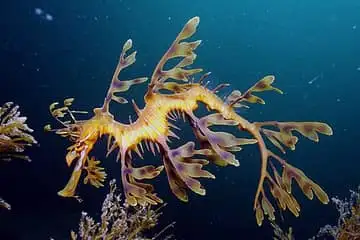
A relative of the seahorse from southern Australia, covered in leaf-like growths that let it vanish among seaweed. As with seahorses, the male carries the eggs, on his tail, and it grows to about 35 cm.
See it on the 3D globe →At a glance
- Class
- Fish
- Diet
- Meat eater (carnivore)
- Conservation status
- Least Concern (IUCN LC)
- Habitat
- coasts
Quick answers
Where does the Leafy sea dragon live?
It lives in coasts of the Indian Ocean.
What does the Leafy sea dragon eat?
Its diet: meat eater (carnivore).
Is the Leafy sea dragon endangered?
It is listed as Least Concern (IUCN LC).
The leafy seadragon (Phycodurus eques) is a fish that looks like a piece of floating seaweed. It belongs to the same family as seahorses and pipefish, and it lives only along the southern and western coasts of Australia. Its whole look, from its snout to its drifting tail, is built to vanish among kelp and seaweed.
Long leaf-like growths stick out from all over its body. They are not used for swimming. They are camouflage. The leafy seadragon is the marine emblem of the state of South Australia and a focus of local ocean conservation. People also call it Glauert's seadragon, and its name comes from the Greek words for seaweed and skin.
A fish disguised as seaweed
The leafy seadragon moves with two small, almost transparent fins: one pair on the sides of its neck and one on its back near the tail. They ripple so gently that the animal seems to drift like a bit of kelp.
It grows to about 20 to 24 centimetres, a little larger than most seahorses, and eats plankton and small crustaceans. It can change colour a little to blend in, depending on its diet, age, location and stress. Unlike a seahorse, it cannot coil its tail around things.
Where to find one
Leafy seadragons live from Wilson's Promontory in Victoria west to Jurien Bay in Western Australia, among rocky reefs, sandy patches near reefs and seagrass or seaweed beds. The water there is cool, and the animals are very delicate, so they struggle to survive outside their natural home.
Scientists once thought each one stayed in a tiny area, but later research showed they can travel hundreds of metres and find their way back home.
Fun facts
- It is the official marine emblem of the state of South Australia.
- Its leaf-like growths are only camouflage and do not help it swim.
- It is related to seahorses, but it cannot curl its tail around things.
- It is the marine emblem of South Australia.
- Its tiny see-through fins ripple so gently that it looks like drifting seaweed.
On the globe
The model shows a leafy seadragon covered in leaf-like frills, off the southern coast of Australia.
More like this

Sources
Updated: 2026-10-14