
Clownfish
흰동가리
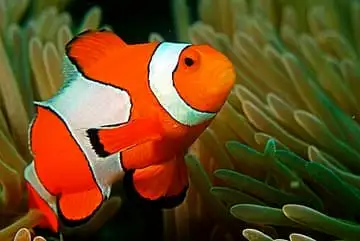
The clownfish lives safely among the stinging tentacles of a sea anemone, protected by a mucus coat. The anemone shelters it from predators. All clownfish start life as males, and the dominant one in a group can become female.
See it on the 3D globe →At a glance
- Class
- Fish
- Lives in
- Coral reefs of the Banda Sea, Indonesia
- Diet
- Eats both plants and meat (omnivore)
- Length
- about 0.11 m
- Lifespan
- up to about 10 years
- Habitat
- coral reefs
Quick answers
Where does the Clownfish live?
It lives in coral reefs of the Indian and Pacific oceans. On the globe you can find it near Coral reefs of the Banda Sea, Indonesia.
How big is the Clownfish?
It grows to about 0.11 m.
What does the Clownfish eat?
Its diet: eats both plants and meat (omnivore).
How long does the Clownfish live?
It can live up to about 10 years.
The clownfish on our globe is the ocellaris clownfish, also called the common or false percula clownfish. It is a small reef fish, about 11 cm long, usually bright orange with three white bands, each edged with a thin black line. It lives on coral reefs in the eastern Indian Ocean and the western Pacific Ocean, in sheltered lagoons and on reef slopes no deeper than about 15 metres.
Clownfish are famous for living among the tentacles of sea anemones, soft animals whose stings can kill small fish. A layer of slimy mucus on the clownfish's skin protects it from the stings. The anemone gives the fish a safe home, and in return the clownfish chases away intruders and keeps its host clean. Marlin and Nemo in the 2003 film Finding Nemo are ocellaris clownfish.
Life in an anemone
Before moving in, a clownfish gets used to its anemone by gently touching the tentacles with different parts of its body, a careful dance that can take a while. Ocellaris clownfish live with three kinds of large sea anemones. Away from the anemone, out in open water, a small fish is in much more danger from predators. The clownfish helps its host too: it removes parasites, its fanning may keep the anemone healthy, and it drives off reef fish that would like to bite the tentacles.
Family life
Clownfish living in one anemone form a group with a strict order of rank. The biggest fish is the female, the next biggest is the breeding male, and the smaller ones wait their turn. Surprisingly, all clownfish are born male. If the female dies, the breeding male changes into a female, and this change cannot be undone. To breed, the male prepares a nest close to the anemone, and the female lays her eggs over one to two hours. The father then guards the eggs and fans them with his fins until they hatch, about six to eight days later.
What it eats
Ocellaris clownfish are omnivores, which means they eat both plants and animals. Their food includes algae, tiny drifting animals called zooplankton, and copepods, which are very small relatives of shrimps. Rank matters at mealtimes too: smaller fish in the group are often chased by the bigger ones, so they have less energy and take more risks when they leave the anemone, and they usually eat less than the dominant fish.
Fun facts
- All clownfish are born male; the largest fish in a group can change into a female.
- Every clownfish starts life as a male, and only the biggest fish in a group becomes the female.
- There are at least 30 kinds of clownfish, but none live in the Caribbean Sea, the Mediterranean Sea or the Atlantic Ocean.
- Some ocellaris clownfish are black with white bands, for example around the Northern Territory of Australia.
- Newly hatched clownfish drift near the surface, then swim down to the reef to find an anemone home.
- After Finding Nemo came out, demand for pet clownfish jumped, and collecting too many from the wild has become a danger to them.
On the globe
The model shows a small orange clownfish in the coral reefs of the Banda Sea in Indonesia. Look for the white bands across its bright orange body.
Quiz time
Which is longer: Clownfish or Blue tang?
Show the answer
Blue tang. (0.11 m vs 0.3 m) Blue tang →
More like this

Sources
Updated: 2026-10-13