
Seahorse
해마
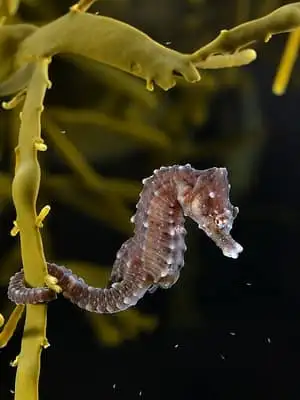
A small fish that swims upright with a horse-shaped head. The male carries the eggs in a belly pouch and gives birth to the young. It anchors itself by curling its tail around seagrass, and its two eyes move independently.
See it on the 3D globe →At a glance
- Class
- Fish
- Diet
- Meat eater (carnivore)
- Lifespan
- up to about 5 years
- Habitat
- coasts, coral reefs
Quick answers
Where does the Seahorse live?
It lives in coasts, coral reefs of the Pacific, Atlantic and Indian oceans.
What does the Seahorse eat?
Its diet: meat eater (carnivore).
How long does the Seahorse live?
It can live up to about 5 years.
Seahorses are small fish that swim upright, with a head shaped like a horse's, a long tube-like snout and a curly tail. They belong to the genus Hippocampus, which has about 47 known species, and they are close relatives of pipefish and sea dragons. The smallest seahorses are only about 1.5 centimetres tall, while the largest can grow to about 35 centimetres.
Seahorses live in shallow, calm salt water in tropical and temperate seas around the world, in places such as seagrass meadows, coral reefs, mangroves and estuaries. They are most famous for an unusual family arrangement: the father, not the mother, becomes pregnant and gives birth to the babies. Their eyes can also move separately, so one eye can look forward while the other looks back.
Amazing body
Instead of scales, a seahorse has thin skin stretched over rings of bony plates, like a suit of armour. It has no tail fin. It moves by fluttering the small fin on its back up to about 70 times a second and steers with tiny fins near its head. Even so, seahorses are very slow swimmers: the dwarf seahorse travels only about 1.5 metres an hour. To avoid being swept away, a seahorse wraps its grasping tail around seagrass or coral and holds on.
Seahorses wait quietly to ambush tiny animals such as copepods and small shrimp, then suck them in through the snout like a vacuum cleaner. They have no stomach, so they need to eat almost all the time.
Family life
Seahorse couples court each other with a slow dance that can last for days, swimming side by side, changing colour and twisting their tails together. The female then places her eggs into a pouch on the male's belly. He carries them for usually about two to four weeks, and then gives birth to tiny, fully formed babies, usually somewhere from about a hundred to a thousand at a time. The babies are on their own from birth, and fewer than one in two hundred survive to grow up.
Is it endangered?
Many seahorse species are in trouble. Their seagrass and coral homes are being damaged, and millions are caught every year, both by accident in fishing nets and on purpose for traditional medicine and aquariums. Since 2002 the international trade in seahorses has been controlled under CITES, a worldwide agreement that protects wild animals and plants from over-trading.
Up to 20 million seahorses may be taken each year for traditional medicine alone.
Fun facts
- In seahorses, it is the male that becomes pregnant and gives birth.
- In seahorses, it is the male that carries the eggs and gives birth.
- A seahorse can move each eye on its own, a bit like a chameleon.
- The dwarf seahorse is one of the slowest fish in the world, moving only about 1.5 metres in an hour.
- Seahorses have no stomach, so they must eat almost constantly.
- A seahorse's back fin can flutter up to about 70 times a second.
On the globe
The model shows a seahorse swimming upright with its horse-shaped head and curled tail. Zoom in to see how its tail curls, ready to grip onto seagrass.
More like this
.jpg)
Sources
Updated: 2026-10-13