
Indian Ocean humpback dolphin
인도양혹등돌고래
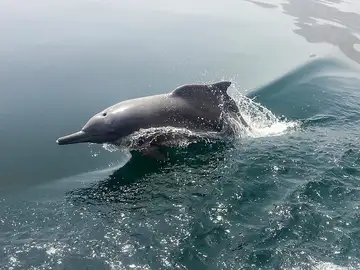
The Indian Ocean humpback dolphin is a gray dolphin with a long beak and a thick hump beneath its tall dorsal fin. It lives in shallow coastal waters of the Arabian Sea and Persian Gulf, usually in small groups of around ten that hunt fish together.
See it on the 3D globe →At a glance
- Class
- Mammals
- Lives in
- Coastal waters of Oman, Arabian Sea
- Diet
- Fish eater
- Conservation status
- Endangered (IUCN EN)
- Habitat
- coasts
Quick answers
Where does the Indian Ocean humpback dolphin live?
It lives in coasts of the Indian Ocean. On the globe you can find it near Coastal waters of Oman, Arabian Sea.
What does the Indian Ocean humpback dolphin eat?
Its diet: fish eater.
Is the Indian Ocean humpback dolphin endangered?
It is listed as Endangered (IUCN EN).
The Indian Ocean humpback dolphin, Sousa plumbea, is a coastal dolphin living from southern Africa to western Indochina, including the shores of East Africa, the Middle East and India. It was long counted as the same species as the Indo-Pacific humpback dolphin, but a 2014 study showed they are separate.
It is a medium-sized dolphin, 2 to 2.8 metres long and 150 to 200 kilograms. It has a fatty hump on its back, which sets it apart from its relative, whose fin is taller and has no hump. Most are dark grey, and young ones are grey too. The most limiting thing for where it lives is water depth, since most animals stay in water shallower than 20 metres. It is currently categorised as Endangered.
Life in the shallows
Because it stays close to shore, this dolphin has been reported in almost every kind of coastal habitat, though which type it prefers depends on the place. It does not make long migrations. When it surfaces, it tilts up at a 30 to 45 degree angle, showing its snout and sometimes the whole head, before arching its back and sometimes showing its tail.
Its food is mostly croakers and related fishes, plus squid and crustaceans.
Social life
It is a social dolphin that usually lives in a group. The average group is about twelve, but sizes vary a lot: some dolphins are alone, and the biggest groups have been more than 100.
There is little evidence of close mixing with other species, though rare friendly and aggressive meetings have been seen with bottlenose dolphins, snubfin dolphins, spinner dolphins and finless porpoises. Where the ranges of the two humpback dolphin species overlap, they can interbreed.
Why it is in trouble
Living in shallow water near people puts this dolphin at risk from habitat damage, being caught in fishing nets, ship strikes and noise. Many calves and young dolphins die. Chemical pollution looks like a major driver: tests on stranded animals found deadly levels of organochlorines.
Important populations have been found along the Arabian coast, especially in Oman and the United Arab Emirates, which hosts one of the world's largest. Some countries have set up protection programmes.
Fun facts
- It has a hump below its dorsal fin and lives in shallow water close to shore.
- It was split from the Indo-Pacific humpback dolphin only in 2014.
- Most stay in water shallower than 20 metres.
- Its hump is made of fat.
- The United Arab Emirates is home to one of the world's largest populations.
On the globe
Look off the coast of Oman in the Arabian Sea; the card describes its long beak and the hump under the dorsal fin.
More like this

Sources
- Read more on Wikipedia
- Indian Ocean humpback dolphin — Wikipedia
- Indian Ocean humpback dolphin — Wikipedia (Korean)
Updated: 2026-10-14