
Arabian oryx
아라비아오릭스
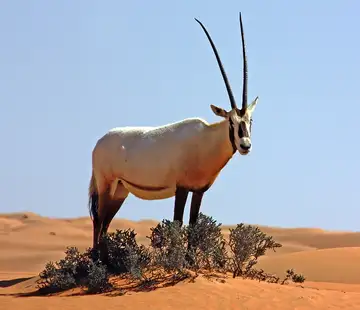
A white desert antelope of the Arabian Peninsula with long, straight horns. It became extinct in the wild in 1972, but captive breeding allowed its reintroduction from the 1980s.
See it on the 3D globe →At a glance
- Class
- Mammals
- Lives in
- Deserts of the Arabian Peninsula (Oman, Saudi Arabia, etc.)
- Diet
- Plant eater (herbivore)
- Weight
- about 70 kg
- Conservation status
- Vulnerable (IUCN VU)
- Habitat
- deserts
Quick answers
Where does the Arabian oryx live?
It lives in deserts. On the globe you can find it near Deserts of the Arabian Peninsula (Oman, Saudi Arabia, etc.).
How big is the Arabian oryx?
It grows to about 70 kg.
What does the Arabian oryx eat?
Its diet: plant eater (herbivore).
Is the Arabian oryx endangered?
It is listed as Vulnerable (IUCN VU).
The Arabian oryx is a medium-sized white antelope of the desert and steppe of the Arabian Peninsula. It has a small bump on its shoulders, a tufted tail and long, straight horns. It is also called the white oryx, and it is the smallest member of the oryx group.
It is famous for a comeback story. By the early 1970s it had died out in the wild, but it was saved in zoos and private reserves and was released back into nature from 1980. In 2011 it became the first animal ever to move from 'Extinct in the Wild' back to 'Vulnerable' on the IUCN Red List. In 2016 about 1,220 lived in the wild and 6,000 to 7,000 in captivity.
Back from the brink
Cars and rifles nearly ended the species. In the 1930s Arabian princes and oil company clerks began hunting oryx from vehicles, and some hunts used as many as 300 vehicles. The last wild oryx before reintroduction was seen in 1972. Animals living in zoos and reserves kept the species alive, and careful breeding provided animals to return to the desert, starting in 1980. They have been released in Oman, Saudi Arabia, the United Arab Emirates, Syria and Jordan. It is listed in CITES Appendix I.
Built for the desert
Its coat is almost luminous white, with brown legs and black markings on the face. Both sexes carry long ringed horns, up to about 1.5 metres. In hot weather it rests during the day and feeds at night, and it lets its body temperature rise to save water. It eats mostly grasses but also buds, herbs, fruit, tubers and roots, and it can follow far-off rain to fresh plants. It can go several weeks without water.
Herds and names
Herds usually have 2 to 15 animals, sometimes up to 100, and they keep a simple pecking order without serious fights. The Arabian wolf is the only predator. The oryx is the national animal of Jordan and Oman, among others.
The scientific name Oryx leucoryx comes from Greek: 'oryx' means gazelle or antelope and 'leukos' means white. The first living one reached Europe, at the Zoological Society of London, in 1857.
Fun facts
- Extinct in the wild by 1972, it became the first animal to move from 'Extinct in the Wild' back to 'Vulnerable' (2011).
- It was the first animal to move from 'Extinct in the Wild' to 'Vulnerable'.
- It became extinct in the wild by the early 1970s.
- About 1,220 lived in the wild in 2016.
- The first living Arabian oryx came to Europe in 1857.
On the globe
The model shows a white desert antelope with long, straight horns, as in the card. Look at the shoulder bump.
Quiz time
Which is heavier: Arabian oryx or Caracal?
Show the answer
Arabian oryx. (70 kg vs 13 kg) Caracal →
More like this

.jpg)
Sources
Updated: 2026-10-14