
Kea
케아
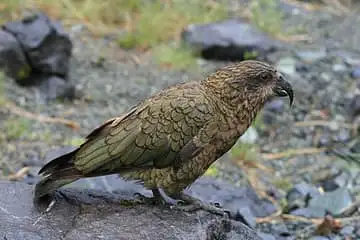
The world's only alpine parrot, so curious and clever it is known for pulling apart car wipers. It lives on snowy New Zealand peaks and has passed puzzle tests that show how well it solves problems.
See it on the 3D globe →At a glance
- Class
- Birds
- Lives in
- Aoraki / Mount Cook, South Island, New Zealand
- Diet
- Eats both plants and meat (omnivore)
- Weight
- about 0.9 kg
- Length
- about 0.48 m
- Conservation status
- Endangered (IUCN EN)
- Habitat
- mountains, forests
Quick answers
Where does the Kea live?
It lives in mountains, forests. On the globe you can find it near Aoraki / Mount Cook, South Island, New Zealand.
How big is the Kea?
It grows to about 0.48 m and 0.9 kg.
What does the Kea eat?
Its diet: eats both plants and meat (omnivore).
Is the Kea endangered?
It is listed as Endangered (IUCN EN).
The kea, Nestor notabilis, is a large parrot found only in the forests and alpine areas of New Zealand's South Island. It is about 46 to 50 cm long and weighs 750 to 1,000 grams. It is mostly olive-green with bright orange under the wings and a long, narrow, curved grey-brown upper beak. It is one of very few parrots that regularly spend time above the tree line, in the southern beech forests of the mountains.
Keas are omnivores. They eat roots, leaves, berries, nectar and insects, and also carrion. They were once killed for a bounty because sheep farmers feared they attacked sheep, but the kea has had full protection since 1986. It is uncommon and is listed as Endangered. It is known for its intelligence and curiosity, which it needs in a harsh mountain home.
Clever and cheeky
Keas can solve logic puzzles, such as pushing and pulling things in a certain order to reach food, and they work together toward a goal. They can wait up to 160 seconds for a more preferred reward, which hints at self-control and planning. They have been filmed preparing and using tools: a bird called Bruce, whose upper beak was broken, wedged pebbles between his tongue and lower beak to help him preen.
Called the clown of the mountains, keas investigate backpacks, boots, skis and cars, pecking and carrying off unguarded items or prying apart rubber parts. One reportedly flew off with a tourist's passport. In 2017 New Zealanders voted it Bird of the Year.
Nests and family
Kea nests are usually on the ground beneath large beech trees, in rock crevices or in burrows between roots. A tunnel one to six metres long leads to a chamber lined with lichens, moss, ferns and rotting wood. The laying season starts in July and reaches into January, and a nest holds two to five white eggs.
Eggs hatch after about 21 days, and the chicks stay in the nest for around 94 days. Life is hard: fewer than 40 percent of young survive their first year. Keas live in groups of up to 13 birds. The oldest known captive kea was 50 years old in 2008.
Sheep and a long argument
Wounds on sheep were noticed in the mid-1860s, a few years after farmers moved into the high country. Suspicion fell on the kea, and a head shepherd saw a kea attack a sheep in 1868. Even Alfred Wallace wrote about it. The wounds seldom kill a sheep directly, but infection or accidents while fleeing can.
Now that keas are protected, most farmers tolerate it, and why only some keas do it is unclear. Evidence suggests only certain birds learned the habit. Kea bones show the bird once lived in lowland forest across much of the North Island, until people and predators drove it into the mountains.
Fun facts
- The kea is the world's only alpine parrot, living in New Zealand's Southern Alps.
- It is one of the few parrots that regularly live above the tree line.
- Its name kea probably imitates its flight call, keee aaa.
- A group of keas is called a circus or a conspiracy.
- A kea once flew off with a tourist's passport in Fiordland National Park.
On the globe
Find it near Aoraki / Mount Cook on the South Island; the card shows the clever mountain parrot.
Quiz time
Which is heavier: Kea or Yellow-eyed penguin?
Show the answer
Yellow-eyed penguin. (0.9 kg vs 5.5 kg) Yellow-eyed penguin →
More like this

Sources
Updated: 2026-10-14