
North Island brown kiwi
키위
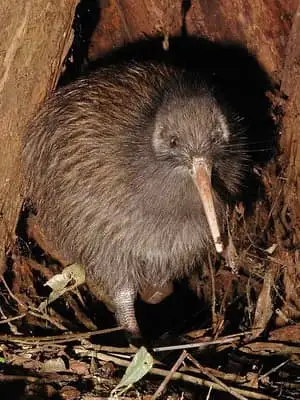
New Zealand's flightless national icon has nostrils at the tip of its long beak to sniff out worms underground. It is active at night and lays an egg so large that it can be about a fifth of the mother's weight.
See it on the 3D globe →At a glance
- Class
- Birds
- Lives in
- East Coast, North Island, New Zealand
- Diet
- Eats both plants and meat (omnivore)
- Weight
- about 2.5 kg
- Length
- about 0.5 m
- Top speed
- about 19 km/h
- Lifespan
- up to about 35 years
- Conservation status
- Vulnerable (IUCN VU)
- Habitat
- forests
Quick answers
Where does the North Island brown kiwi live?
It lives in forests. On the globe you can find it near East Coast, North Island, New Zealand.
How big is the North Island brown kiwi?
It grows to about 0.5 m and 2.5 kg.
What does the North Island brown kiwi eat?
Its diet: eats both plants and meat (omnivore).
How fast is the North Island brown kiwi?
It can reach about 19 km/h.
How long does the North Island brown kiwi live?
It can live up to about 35 years.
Is the North Island brown kiwi endangered?
It is listed as Vulnerable (IUCN VU).
The North Island brown kiwi, Apteryx mantelli, is a nocturnal, flightless bird found across the northern two-thirds of New Zealand's North Island. It is the most common kiwi species, though the IUCN rates it Vulnerable. The estimate was about 35,000 birds in 2000, and about 20,000 in 2006. It has spiky, streaky brown feathers and a long bill 13 to 20.5 centimetres long.
Females are bigger than males: males weigh about 1.4 to 3.1 kg and females about 2.1 to 3.9 kg. The kiwi is a national symbol of New Zealand. Its eggs are among the largest of any bird relative to body size, and its genome was sequenced in 2015. It lives mostly in dense lowland and coastal native forest, but it has adapted to many other kinds of habitat.
Finding food in the dark
A kiwi spends most of its time foraging. Spiders and worms and other invertebrates make up 85 to 95 percent of what it eats, with the rest plants. It has the smallest field of vision recorded for any bird that hunts without relying on sight, which suits life on a dark forest floor.
It finds food by smell and by touch. The nostrils are at the tip of the long bill, and a sensory organ at the bill tip can detect prey that is deep in the soil.
A giant egg and a dad on duty
Kiwis pair up for the long term. Before the breeding season they prepare a nest underground, in a rock crevice, or in a hollow among tree roots, lining it with fern fronds. The female lays one to five eggs in a clutch; a full brood has two, and each egg is about 12.5 by 7.8 cm and weighs about 430 g.
After that, the male does all the incubating. He grows a brood patch on his belly, turns the eggs, and hides the nest entrance with leaves and soil when he leaves to feed. He goes out for about five hours at a time.
Saving the kiwi
The main danger is predators such as dogs, cats and stoats. In places with no pest control, about 94 percent of chicks die before breeding, and on average only about 5 percent survive to adulthood nationwide.
Pest control works. At Tongariro Forest, 57 percent of radio-tagged chicks survived after a 2006 operation, and the adult population almost doubled since 1998. Kiwi were released on Wellington's south coast in 2022 after 100 years away.
Fun facts
- The kiwi is the only bird with nostrils at the tip of its beak.
- The female's egg is among the largest relative to body size of any bird.
- Kiwis have a sensory organ at the tip of the bill that feels prey underground.
- The male sits on the eggs while the female does not incubate at all.
- Eleven kiwi were released on Wellington's south coast in 2022 after about 100 years away.
On the globe
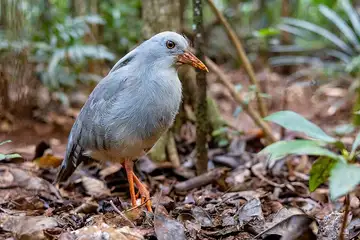
Find it on the east coast of New Zealand's North Island; the card shows its long bill with nostrils at the tip.
Quiz time
Which is heavier: North Island brown kiwi or Kea?
Show the answer
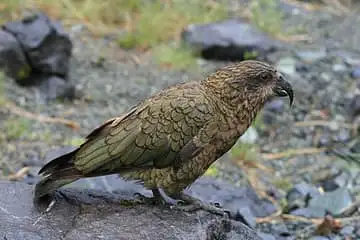
North Island brown kiwi. (2.5 kg vs 0.9 kg) Kea →
More like this


Sources
Updated: 2026-10-14