
Mahi-mahi
만새기
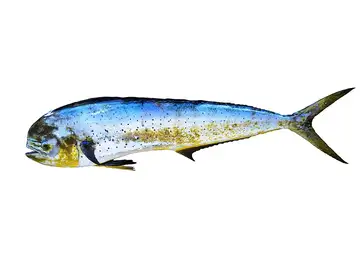
The mahi-mahi is a fast surface fish of warm seas worldwide. It has a blunt, steep forehead, a dorsal fin running from head to tail, and a green-gold body dotted with blue. It grows very fast and can mature in about a year.
See it on the 3D globe →At a glance
- Class
- Fish
- Lives in
- Open warm seas, here the central Atlantic near the equator
- Diet
- Fish eater
- Weight
- about 10 kg
- Length
- about 1 m
- Conservation status
- Least Concern (IUCN LC)
- Habitat
- open ocean
Quick answers
Where does the Mahi-mahi live?
It lives in the open ocean of the Atlantic, Pacific and Indian oceans. On the globe you can find it near Open warm seas, here the central Atlantic near the equator.
How big is the Mahi-mahi?
It grows to about 1 m and 10 kg.
What does the Mahi-mahi eat?
Its diet: fish eater.
Is the Mahi-mahi endangered?
It is listed as Least Concern (IUCN LC).
The mahi-mahi, Coryphaena hippurus, also called the common dolphinfish or dorado, is a surface-dwelling fish of warm and temperate seas all over the world. It is especially common around the Gulf of Mexico, Costa Rica, Hawaii and the Indian Ocean. It has a flattened body and one very long dorsal fin that runs from the head almost to the tail. The colours are dazzling: golden sides, bright blue and green on the back and sides, and iridescent blue pectoral fins.
Males have a high, bulging forehead that grows as they mature, while females have a rounded head. Catches are usually 7 to 13 kilograms and about a metre long, and a fish over 18 kilograms is exceptional. A mahi-mahi can swim as fast as about 50 knots, roughly 93 km/h, when chasing prey. Out of the water it changes colour, which is why the Spanish name dorado means golden.
Why the odd names?
Mahi-mahi comes from the Hawaiian language and means very strong. The name dolphinfish was only recently adopted to avoid confusion with dolphins, which are mammals and unrelated, because the fish was traditionally also called dolphin.
In Italy it is called corifena, lampuga or pesce capone, and young fish that migrate past Malta are called lampuki. Linnaeus named the genus in 1758 from a Greek word meaning top or apex. A constellation named Dorado, created in 1598, honours the fish.
Fast living
Mahi-mahi are among the fastest-growing fish. They live up to five years, though seldom beyond four. Both sexes are mature in the first year, often at 4 to 5 months old. A female may spawn two or three times a year and produce between 80,000 and 1,000,000 eggs each time.
Young mahi-mahi are often found in rafts of floating Sargassum weed. They usually live near the surface of the open sea.
What it eats and how people find it
Mahi-mahi are carnivores. They eat small fish such as flying fish and triggerfish, the larvae of reef fish, crabs and other crustaceans, squid, jellyfish, and the young of tuna and other large fish, plus zooplankton.
Sport fishers like them for their beauty, size and healthy numbers. Guides look for floating debris, weed lines, buoys and frigatebirds near the reef edge, because mahi-mahi gather beneath floating objects. In Malta and Sicily they are caught under floating mats of palm leaves.
Fun facts
- Also called dolphinfish (though it is not a dolphin), it flashes gold, green and blue, colours that fade quickly after death.
- The name mahi-mahi means very strong in Hawaiian.
- It can swim as fast as about 50 knots.
- It changes colour through several shades after being pulled from the water.
- The constellation Dorado is named after this fish.
On the globe
The model shows a green-gold mahi-mahi with blue spots and a tall forehead near the sea surface.
Quiz time
Which is heavier: Mahi-mahi or Atlantic bluefin tuna?
Show the answer
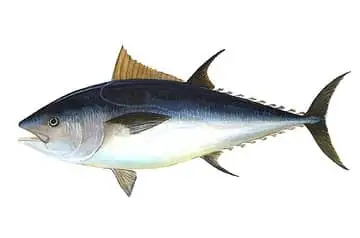
Atlantic bluefin tuna. (10 kg vs 240 kg) Atlantic bluefin tuna →
More like this
_(Ifremer_00763-87546).jpg)
Sources
Updated: 2026-10-14