
Skipjack tuna
가다랑어
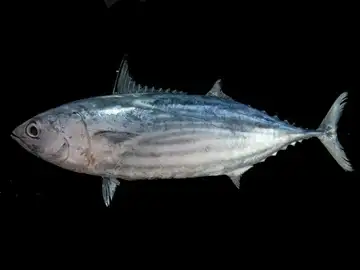
The skipjack is a small tuna that travels in huge schools through tropical and warm seas. It has a silvery body with dark stripes along the belly and usually reaches about 80 cm. It is among the most heavily caught tunas, used for cans and katsuobushi.
See it on the 3D globe →At a glance
- Class
- Fish
- Lives in
- Tropical and warm seas worldwide, here the equatorial Atlantic
- Diet
- Fish eater
- Length
- about 0.8 m
- Conservation status
- Least Concern (IUCN LC)
- Habitat
- open ocean
Quick answers
Where does the Skipjack tuna live?
It lives in the open ocean of the Pacific, Atlantic and Indian oceans. On the globe you can find it near Tropical and warm seas worldwide, here the equatorial Atlantic.
How big is the Skipjack tuna?
It grows to about 0.8 m.
What does the Skipjack tuna eat?
Its diet: fish eater.
Is the Skipjack tuna endangered?
It is listed as Least Concern (IUCN LC).
The skipjack tuna (Katsuwonus pelamis) is a streamlined, fast-swimming fish of the tuna family that lives in tropical and warm-temperate waters all over the world. It is the only member of the genus Katsuwonus. It commonly reaches a fork length of up to 80 centimetres and 8 to 10 kilograms, and the largest are 1.08 metres and 34.5 kilograms.
It lives in surface waters in large shoals of up to 50,000 fish, often mixed with other tunas, feeding on fish, crustaceans, squid and other molluscs. It is an important prey for sharks and large ocean fish, and is often used as live bait for marlin. It has no scales except along the lateral line and in a thick band behind the head called the corselet. It is also one of the most important fishing species in the world.
Built to swim
Skipjack tuna have the highest share of muscle used for movement of any animal, 68 percent of their body mass. Like other tuna, they have no swim bladder, so they must keep swimming to stay afloat.
They are batch spawners. Spawning goes on all year in equatorial waters and becomes more seasonal farther away. A skipjack can spawn when it is about 45 centimetres long. It is the most fecund of the main commercial tunas. Their age is hard to tell, with estimates of a potential lifespan of 8 to 12 years.
A fishery of millions of tonnes
Skipjack is usually caught with purse seine nets and sold fresh, frozen, canned, dried, salted and smoked. In 2018 landings of 3.2 million tonnes were reported, the third highest of any marine capture fishery, after Peruvian anchoveta and Alaska pollock. Big catches are recorded by the Maldives, France, Spain, Malaysia, Sri Lanka and Indonesia.
The population is considered sustainable at current use, but the fishing is still controversial. Some authorities call purse seining unsustainable because of bycatch, though bycatch is said to be much lower when floating fish-aggregation devices are not used.
Katsuo in Japan
In Japan the skipjack is called katsuo, and the genus name Katsuwonus comes from that word. It is eaten raw in sushi and sashimi, lightly seared as katsuo tataki, and smoked and dried to make katsuobushi, whose shavings flavour the stock called dashi and top rice balls and tofu.
The fat content changes as the fish migrate along the Japanese islands. Those heading north in summer are called hatsugatsuo, or first katsuo, and carry less fat.
Fun facts
- It is the most-caught tuna in the world and is used for most canned tuna.
- Over two thirds of its body mass is swimming muscle.
- It must keep swimming to stay afloat.
- The Japanese name katsuo gave the genus name Katsuwonus.
- Schools can have up to 50,000 fish.
On the globe
The toy model shows a skipjack tuna in the equatorial Atlantic, where it travels in big schools.
Quiz time
Which is longer: Skipjack tuna or Mahi-mahi?
Show the answer
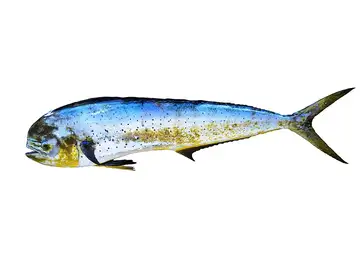
Mahi-mahi. (0.8 m vs 1 m) Mahi-mahi →
More like this

Sources
Updated: 2026-10-14