
White-nosed coati
흰코코아티
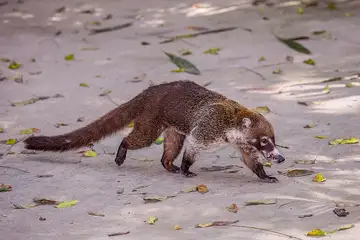
The white-nosed coati is a relative of the raccoon with a long, flexible snout and a ringed tail. Bands of coatis forage by day, sniffing out insects in leaf litter, and walk with their tails held straight up.
See it on the 3D globe →At a glance
- Class
- Mammals
- Lives in
- Forests of Central and South America (e.g. Colombia)
- Diet
- Eats both plants and meat (omnivore)
- Conservation status
- Least Concern (IUCN LC)
- Habitat
- forests, rainforests
Quick answers
Where does the White-nosed coati live?
It lives in forests, rainforests. On the globe you can find it near Forests of Central and South America (e.g. Colombia).
What does the White-nosed coati eat?
Its diet: eats both plants and meat (omnivore).
Is the White-nosed coati endangered?
It is listed as Least Concern (IUCN LC).
The white-nosed coati, or coatimundi, is a long-tailed relative of the raccoon. It lives in woodlands from the southwestern United States through Mexico and Central America to north-western Colombia, from sea level up to about 3,000 metres.
It weighs about 4 to 6 kilograms and is about 110 centimetres long from nose to tail tip, and the tail makes up half of that. Its long, flexible snout is perfect for poking into leaf litter. Its Spanish names include pizote and gato solo, and in some places it is also called a coatimundi. The animals are mostly active during the day and are good at climbing.
Life in a band
Females and young live in noisy bands that search for food by day. They sniff out insects in the leaves on the forest floor and walk with their ringed tails held straight up.
Adult males usually live alone and join a band only in the breeding season. The long nose and flexible snout help it find insects and small animals while the troop forages.
Where is it found?
Local people use names such as pizote, gato solo and tejón for it. It prefers tropical and subtropical dry and moist broadleaf forests.
Coatis have also been found in Florida, where they were introduced after escaping from captivity. Mothers and young often climb trees to sleep or to escape danger. Escapees from captivity are thought to have started the Florida group, which now seems well established.
Fun facts
- Females and young live in noisy bands, while adult males usually live alone.
- Half of its length is tail.
- Bands walk with tails held straight up.
- It is a relative of the raccoon.
On the globe
The model shows a coati with a long snout and a ringed tail held upright.
More like this
_Peten.jpg)
Sources
Updated: 2026-10-14