
Marco Polo sheep
마르코폴로양
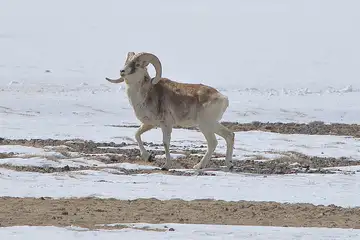
The Marco Polo sheep is a subspecies of argali living on the Pamir plateau. It is named after Marco Polo, who described it while crossing the region in the 13th century. Its horns spiral widely outward and exceed a metre in length.
See it on the 3D globe →At a glance
- Class
- Mammals
- Lives in
- Pamir plateau (Tajikistan, China, Afghanistan)
- Diet
- Plant eater (herbivore)
- Habitat
- mountains
Quick answers
Where does the Marco Polo sheep live?
It lives in mountains. On the globe you can find it near Pamir plateau (Tajikistan, China, Afghanistan).
What does the Marco Polo sheep eat?
Its diet: plant eater (herbivore).
The Marco Polo sheep (Ovis ammon polii) is a subspecies of argali, the largest wild sheep, and it lives in the high mountains of Central Asia. Most of them live in the Pamir Mountains, where the borders of Afghanistan, Pakistan, Kyrgyzstan, Tajikistan and China meet, at heights of about 3,700 to 4,800 metres. It is easy to recognise by its large size and its widely spiralling horns.
It is named after the 13th-century explorer Marco Polo, because it was described in The Travels of Marco Polo. The zoologist Edward Blyth first described it scientifically in 1841. Mature rams weigh around 126 kilograms on average. Today it is listed as near threatened, and efforts have been made to protect it from hunting.
The longest horns of any sheep
The horns can span up to 140 centimetres, and the longest single horn ever recorded was 1.9 metres long and weighed about 27 kilograms. They coil so that the tips point straight out to the sides, yet the tips are rarely broken. Horns start growing 15 to 20 days after birth, and they grow longest in the first year and thickest in the first two.
Each year the horns gain a ring, so the age of a male can be read from them. Females have no big horns, so their age is harder to tell.
Life in the Pamirs
Marco Polo sheep live in small flocks of a few dozen. In summer they split into smaller flocks of the same sex, and in winter they gather in larger groups for protection and to save energy. They prefer areas near streams and plants in summer and gentler, south-facing slopes in winter, and they share the mountains with Siberian ibex.
In the rut, around December, mature rams over six years old fight for dominance. They spin around side by side, then one steps back and charges. Marco Polo rams even rear up on their hind legs, much like goats do. Ewes usually have one lamb after about 160 days.
Coat and names
Argali are dark brown with white underparts, separated by a dark band of hair, and have a white patch on the rump that is clearest in the Marco Polo sheep. In winter the males grow a white ruff. Its tail is a little longer than that of other argali.
It is also called Marco Polo's argali or the Pamir argali. Locally it is known as nakhjipar in Badakhshan, Afghanistan, and ra-ma-poy in Wakhi, the language of people near the Khunjerab Pass.
Fun facts
- This Pamir argali is named after Marco Polo, who described it, and its curling horns can be longer than 1.8 m.
- It has the longest horns of any sheep.
- The longest single horn recorded was 1.9 m long and weighed about 27 kg.
- It was named after Marco Polo's travel book.
- Its horns start growing within three weeks of birth.
On the globe
The model shows a Marco Polo sheep with its huge spiralling horns on the high Pamir plateau.
More like this

Sources
Updated: 2026-10-14