
Nudibranch (sea slug)
갯민숭달팽이(해양 민달팽이)
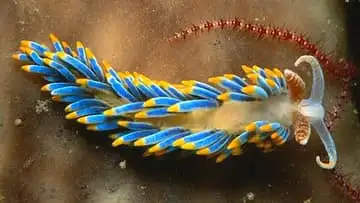
A shell-less sea slug whose bright colours warn predators that it tastes bad or is poisonous. Some species even keep the stinging cells of the anemones and corals they eat and reuse them for defence. Reefs of the Red Sea have many.
See it on the 3D globe →At a glance
- Class
- Molluscs
- Diet
- Meat eater (carnivore)
- Habitat
- coral reefs, coasts
Quick answers
Where does the Nudibranch (sea slug) live?
It lives in coral reefs, coasts of the Pacific, Atlantic, Indian, Arctic and Southern oceans.
What does the Nudibranch (sea slug) eat?
Its diet: meat eater (carnivore).
Nudibranchs are soft-bodied marine snails that lose their shells after the larva stage, and about 3,000 species are known. They live in seas worldwide, from the Arctic through temperate and tropical waters to the Southern Ocean around Antarctica, almost entirely in salt water. Most crawl over the seabed, and sizes range from 4 millimetres to 600 millimetres.
They are noted for extraordinary colours and striking forms, and have been given nicknames such as clown, marigold, splendid, dancer, dragon and sea rabbit. The word nudibranch comes from the Latin nudus, naked, and the Greek branchia, gills, because many wear their gills on the outside of the body. They are often called sea slugs, but many sea slugs belong to groups that are not closely related to them.
Gills on show
Dorid nudibranchs breathe through a rosette of feathery gills on their backs. The other big group, the aeolids, have rows of brightly coloured, finger-like growths called cerata instead. Some of the cerata are venomous and help drive off predators.
Nudibranchs have head tentacles that sense touch, taste and smell, and club-shaped rhinophores that detect odours. Their eyes are only about a quarter of a millimetre across, and they can tell little more than light from dark.
Colours, camouflage and borrowed stings
Having lost their shells, nudibranchs developed other ways to stay safe. Some copy the textures and colours of the sponges or soft corals they eat, to hide. Others, like Chromodoris quadricolor, have intensely bright patterns that stand out as a warning.
Some species that eat hydroids keep the prey's stinging cells and store them in their cerata, a trick called kleptocnidae. Scientists still do not know exactly how they avoid being stung while eating them. Many rely on chemicals that taste bad rather than being deadly.
Life cycle and food
Nudibranchs are hermaphrodites, with the organs of both sexes, but they cannot fertilise themselves. Mating takes a few minutes and involves a dance-like courtship. Eggs are laid in a jelly spiral, often like a ribbon, and the young look almost like small adults. A nudibranch lives from a few weeks to a year, depending on the species.
All known nudibranchs are carnivores. Different groups eat sponges, hydroids, sea squirts, barnacles, anemones or bryozoans, and some eat other sea slugs or their eggs. The only deep-water species known, Bathydevius, was found near 2,500 metres and is one of very few that glow.
Fun facts
- Some nudibranchs eat stinging animals and store the stinging cells in their own bodies for defence.
- About 3,000 species are known.
- One species was found near 2,500 metres deep, and it can make its own light.
- Photosynthetic sea slugs, often confused with nudibranchs, are not true nudibranchs.
- One sea slug species has been estimated to lay as many as 25 million eggs.
On the globe
The model shows a brightly coloured nudibranch crawling over the reef.
More like this
.jpg)
Sources
Updated: 2026-10-14