
Pearl oyster
진주조개
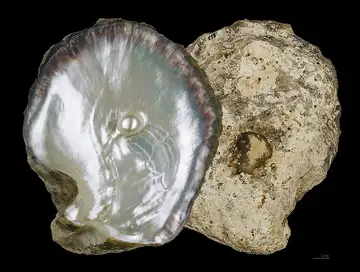
The black-lip pearl oyster is a large bivalve whose shell is lined with iridescent mother-of-pearl, attached to rocks and coral. It produces Tahitian black pearls, and the Persian Gulf has long been famed for pearl diving.
See it on the 3D globe →At a glance
- Class
- Molluscs
- Lives in
- Persian Gulf near Bahrain
- Diet
- Filter feeder
- Habitat
- coral reefs, coasts
Quick answers
Where does the Pearl oyster live?
It lives in coral reefs, coasts of the Pacific, Indian and Atlantic oceans. On the globe you can find it near Persian Gulf near Bahrain.
What does the Pearl oyster eat?
Its diet: filter feeder.
The black-lip pearl oyster (Pinctada margaritifera) is a large saltwater shellfish that lives on tropical coral reefs. Its shell is dark grey-brown or green on the outside, often with white spots, and shiny mother-of-pearl on the inside. Adults are usually about 20 to 25 centimetres tall.
It is common across the Indo-Pacific and is best known for making pearls, including the famous Tahitian black pearls. People harvest it in the wild and also raise it on farms. The Persian Gulf, here shown near Bahrain, has long been famous for pearl diving. The name 'black-lip' comes from the dark colour around the edge of the shell's inner surface.
How a pearl forms
A pearl begins when something irritating gets inside the oyster, such as a parasite or a tiny particle. To protect itself, the oyster covers the object with thin layers of shiny nacre, the same material that lines its shell. Over time, a small pearl grows. It is a popular myth that a grain of sand is the usual cause. The pearls of this species are generally considered the highest-quality pearls of all the pearl oysters.
Life on the reef
The oyster attaches itself to rocks, coral and barnacles with strong threads called a byssus. It lives from the low-tide line down to about 75 metres, in clear water with few nutrients, and it feeds by filtering tiny particles from the water. Its range stretches from the Red Sea and Persian Gulf to French Polynesia, Australia, Japan and the coasts of India. Many other animals, including sponges, worms and fish, live around pearl oyster beds.
Fun facts
- A pearl forms when the oyster coats an irritating particle with layer after layer of nacre.
- The hinge of this oyster has no teeth, which helps to tell it apart from similar shells.
- A pearl is made of layer after layer of nacre.
- Sand is not usually what starts a pearl; that is a popular myth.
On the globe
The model shows a black-lip pearl oyster in the Persian Gulf near Bahrain. Look for its rough outer shell and shiny mother-of-pearl inside.
More like this

Sources
Updated: 2026-10-14