
Southern right whale
남방긴수염고래
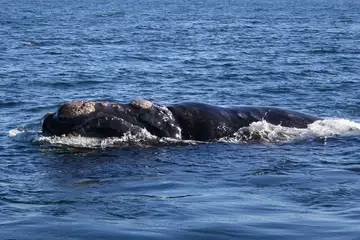
A big whale of the cold Southern Hemisphere, easily recognised by its lack of a dorsal fin and the white callosities on its head. It is about 15-17 m long with a strongly arched mouth, and is recovering after whaling.
See it on the 3D globe →At a glance
- Class
- Mammals
- Lives in
- Southwest Atlantic off Argentina
- Diet
- Filter feeder
- Length
- about 15 m
- Conservation status
- Least Concern (IUCN LC)
- Habitat
- coasts, open ocean
Quick answers
Where does the Southern right whale live?
It lives in coasts, open ocean of the Southern, Atlantic, Pacific and Indian oceans. On the globe you can find it near Southwest Atlantic off Argentina.
How big is the Southern right whale?
It grows to about 15 m.
What does the Southern right whale eat?
Its diet: filter feeder.
Is the Southern right whale endangered?
It is listed as Least Concern (IUCN LC).
The southern right whale (Eubalaena australis) is a large baleen whale found throughout the Southern Hemisphere, in oceans between about 20 and 60 degrees south. Like its northern relatives it has a broad back with no dorsal fin, a long arching mouth, and white growths on its head called callosities. The skin is very dark grey or black. It was hunted for hundreds of years almost to extinction and is now protected.
An adult female is about 15 metres long and can weigh up to 47 tonnes, and the largest records are 17 to 18 metres and 80 tonnes. Each side of the upper jaw has 200 to 270 narrow baleen plates about 3 metres long. The global population was estimated at around 13,600 in 2009, and it has been growing about 7 percent a year. In 2017 the IUCN listed it as least concern.
Callosities and tail sailing
The rough patches on the head look white because they are covered by large colonies of cyamids, or whale lice. Their pattern is different on every whale. Scientists have proposed that callosities help with protection, identification and mating, but their purpose is unclear.
Southern right whales are active at the surface and curious about boats. They have a trick found only in this species, called tail sailing, where a whale lifts its flukes into the air to catch the wind and stays in place for quite a while. It seems to be play, and is seen most often off Argentina and South Africa.
Calving grounds and calves
Each year the whales migrate. In summer they feed on zooplankton and krill in the cold Southern Ocean, often near Antarctica, and in winter they travel north to coastal waters off Argentina, Australia, Brazil, South Africa and New Zealand to breed. Females return to the same calving grounds, usually every three years, and calves are born between June and November.
A calf is born after a year in the womb, weighing about one tonne and 4 to 6 metres long, and it stays with its mother for the first year, doubling in length. In Australia, whales like the Head of the Bight, where breaking waves may mask their sounds and protect calves from killer whales, their only known predator.
Hunted, then protected
Southern right whales were the main target of whalers, who killed tens of thousands from the 18th to the 20th century, and that is why they were the right whale to hunt. They were hunted heavily in Australia and New Zealand from 1800 to 1850, and industrial whaling in the 20th century took many more.
International protection began in 1937, though illegal whaling by the Soviet Union continued into the 1970s. Today whale watching is popular, but ship strikes, entanglement in fishing gear and pollution remain threats. A 2024 study found that the median lifespan is around 73 years, with some individuals living past 130.
Fun facts
- The rough pale patches on its head, called callosities, form a pattern unique to each whale.
- The callosity pattern is different on every whale.
- It may use its tail like a sail.
- It has no dorsal fin.
- It was called the right whale because it was the right one to hunt.
On the globe
The toy model shows a southern right whale in the southwest Atlantic off Argentina.
Quiz time
Which is longer: Southern right whale or Patagonian mara?
Show the answer
Southern right whale. (15 m vs 0.72 m) Patagonian mara →
More like this

Sources
Updated: 2026-10-14