
South American sea lion
남아메리카바다사자
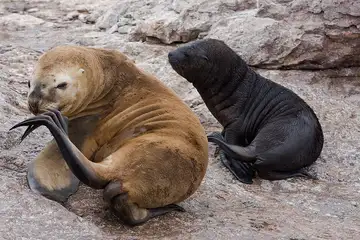
Large sea lion of South American coasts. Males have a lion-like mane and a blunt, upturned snout, and weigh up to about 350 kg, far more than females. They gather in big colonies on rocky and sandy shores.
See it on the 3D globe →At a glance
- Class
- Mammals
- Lives in
- Peru to Chile and Argentina to Brazil coasts
- Diet
- Fish eater
- Conservation status
- Least Concern (IUCN LC)
- Habitat
- coasts
Quick answers
Where does the South American sea lion live?
It lives in coasts of the Pacific and Atlantic oceans. On the globe you can find it near Peru to Chile and Argentina to Brazil coasts.
What does the South American sea lion eat?
Its diet: fish eater.
Is the South American sea lion endangered?
It is listed as Least Concern (IUCN LC).
The South American sea lion is a large sea lion found along the west and southeast coasts of South America, from Peru around Cape Horn and north to southern Brazil. Males have a big head with a short, upturned snout and a mane of long fur that reaches the shoulders, which is why they look like little lions.
It is one of the biggest and most unevenly sized eared seals: males reach about 3 metres and 350 kilograms, while females are about 2 metres and 150 kilograms. The overall population is thought to be stable, at roughly 265,000 animals. It is the only living member of its genus, Otaria.
Where does it live?
These sea lions rest and breed on beaches made of sand, gravel, rocks or pebbles, and sometimes on flat rocky cliffs with tide pools. Well-known breeding colonies include Lobos Island in Uruguay, Peninsula Valdes in Argentina, the Beagle Channel and the Falkland Islands. A few wanderers travel north to southern Ecuador, but they apparently never breed there. Colonies tend to be small and scattered, especially on rocky shores.
Food and family
They mainly eat fish and cephalopods such as squid. Breeding males usually defend both a territory and individual females, though this can vary. Less dominant males sometimes try to win success by causing chaos in the group. Pups are born black, about 86 centimetres long, and turn reddish-brown after their first moult. Their natural enemies include killer whales and some big sharks.
Fun facts
- Males have a big head and thick mane that make them look like a lion.
- Males have a mane, and females are nearly yellowish in colour.
- Pups are born black and turn reddish-brown after the first moult.
- Local names include lobo marino, or sea wolf.
- There is no evidence of a winter migration of the sea lions in the Falklands.
On the globe
The toy model shows a maned male sea lion on a South American shore; look along the coasts of Peru, Chile, Argentina and Brazil.
More like this

Sources
Updated: 2026-10-14