
Southern pudú
푸두
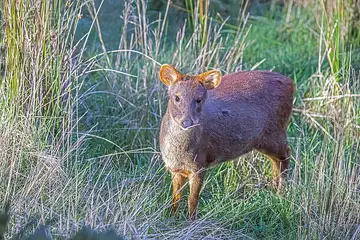
One of the smallest deer in the world, living in the temperate rainforests of southern Chile and Argentina. It stands only about 40 cm at the shoulder, and males carry spike antlers of about 5 to 10 cm.
See it on the 3D globe →At a glance
- Class
- Mammals
- Lives in
- Temperate rainforest, southern Chile
- Diet
- Plant eater (herbivore)
- Weight
- about 10 kg
- Conservation status
- Near Threatened (IUCN NT)
- Habitat
- forests, rainforests
Quick answers
Where does the Southern pudú live?
It lives in forests, rainforests. On the globe you can find it near Temperate rainforest, southern Chile.
How big is the Southern pudú?
It grows to about 10 kg.
What does the Southern pudú eat?
Its diet: plant eater (herbivore).
Is the Southern pudú endangered?
It is listed as Near Threatened (IUCN NT).
The southern pudu (Pudu puda) is one of the smallest deer in the world. It stands only about 35 to 45 centimetres tall at the shoulder and weighs roughly 6 to 13 kilograms. Its coat is a dark chestnut brown, and the fur often tufts at the front, covering its tiny antlers.
It lives in the temperate rainforests of southern Chile and nearby Argentina. Males grow short spike antlers of about 5 to 9 centimetres that curve backward, a bit like a mountain goat's horns. The species is rated Near Threatened, mostly because its forest habitat is being lost. It prefers dense bushes where it can hide.
Forest and bamboo
The pudu lives in forests, from sea level up to about 1,700 metres. It likes places with a dense layer of bushes, though it comes out to feed in open spaces rich in plants. In the Chilean Coast Range it lives in broadleaf evergreen and alerce forests. In the southern Andes it is found in thickets of bamboo. The name pudu comes from the Mapuche language.
Separate islands of deer
Studies of the pudu's genes show that populations in different places are quite different from each other and mix little. The pudus of Chiloé Island have been separated from the mainland for more than 200,000 years, and may be their own subspecies. This makes each group valuable, but also fragile. If a group becomes very small, it cannot easily be refilled by animals from nearby areas.
Fun facts
- It is one of the smallest deer in the world, standing only about 40 cm at the shoulder.
- Its antlers are only about 5 to 9 centimetres long.
- The word pudu comes from the Mapuche language.
- The deer on Chiloé Island may be a subspecies of their own.
On the globe
The model shows a southern pudu in the temperate rainforest of southern Chile. Look for the tiny body and short spike antlers.
Quiz time
Which is heavier: Southern pudú or Patagonian mara?
Show the answer
Patagonian mara. (10 kg vs 12 kg) Patagonian mara →
More like this
_female_Chiloe.jpg)
Sources
Updated: 2026-10-14