
Sable
검은담비
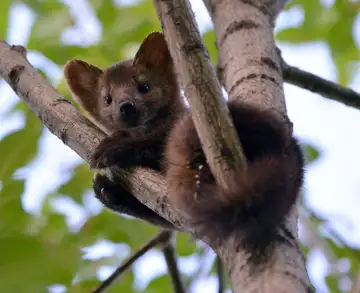
The sable is a slender marten of the Siberian taiga. Its silky fur was so valuable it was called "soft gold", and the fur trade helped drive Russia's eastward expansion across Siberia.
See it on the 3D globe →At a glance
- Class
- Mammals
- Lives in
- Siberian taiga
- Diet
- Eats both plants and meat (omnivore)
- Weight
- about 1.2 kg
- Conservation status
- Least Concern (IUCN LC)
- Habitat
- forests
Quick answers
Where does the Sable live?
It lives in forests. On the globe you can find it near Siberian taiga.
How big is the Sable?
It grows to about 1.2 kg.
What does the Sable eat?
Its diet: eats both plants and meat (omnivore).
Is the Sable endangered?
It is listed as Least Concern (IUCN LC).
The sable is a slender marten, a small meat-and-plant eating mammal of the weasel family, that lives in the forests of Siberia. It has soft, silky fur that ranges from light to dark brown, a long head and long ears. Males are 38 to 56 centimetres long and weigh 880 to 1,800 grams, a bit more than females.
Its home stretches from the Ural Mountains across Siberia to the Pacific, and it also lives in northern Mongolia, parts of China, North Korea and Hokkaido in Japan. It is a skilled climber and hunts mostly by sound and smell. It eats rodents, small birds, eggs, nuts and berries. The IUCN lists it as Least Concern. The globe places it in the Siberian taiga.
Soft gold
Sable fur has been prized since the early Middle Ages for being softer and silkier than the fur of American martens. It became so valuable that it was nicknamed soft gold, and the fur trade helped push Russia to expand eastwards across Siberia. Because of the fur trade the sable was hunted hard, and in Russia about 19,000 animals were released between 1940 and 1965 to bring them back to their old range.
Life in the taiga
Sables mate between June and August, and a litter usually has two or three young. The sable looks much like the pine marten but has a longer head, longer ears and a shorter tail. The name sable seems to be of Slavic origin and travelled into other European languages along the fur trade routes. In Korea the sable lives on the Gaema Plateau and Mount Baekdu, and North Korea protects it as a natural monument.
Fun facts
- Its silky fur was so valuable that the sable trade helped drive Russia's expansion across Siberia.
- Its fur was so valuable that people called it soft gold.
- About 19,000 sables were released across Russia between 1940 and 1965.
- The word sable comes from the Slavic word for the animal and spread through the fur trade.
On the globe
The globe places the sable in the Siberian taiga. Look for the slim brown body with a pale patch on the throat.
Quiz time
Which is heavier: Sable or Mongolian gazelle?
Show the answer
Mongolian gazelle. (1.2 kg vs 30 kg) Mongolian gazelle →
More like this

Sources
Updated: 2026-10-14