
Pallas's cat
마눌고양이
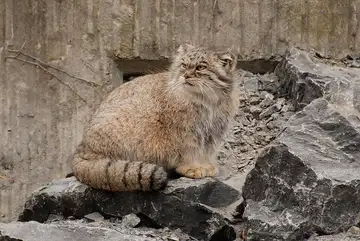
Pallas's cat is a small wild cat of the rocky steppes and mountains of Central Asia. It has a stocky body, very long dense fur, and small low-set ears. Unusually for a small cat, its pupils are round rather than slit.
See it on the 3D globe →At a glance
- Class
- Mammals
- Lives in
- Steppes and mountains of Central Asia, incl. western Mongolia
- Diet
- Meat eater (carnivore)
- Weight
- about 3.5 kg
- Length
- about 0.8 m
- Conservation status
- Least Concern (IUCN LC)
- Habitat
- grasslands, mountains, deserts
Quick answers
Where does the Pallas's cat live?
It lives in grasslands, mountains, deserts. On the globe you can find it near Steppes and mountains of Central Asia, incl. western Mongolia.
How big is the Pallas's cat?
It grows to about 0.8 m and 3.5 kg.
What does the Pallas's cat eat?
Its diet: meat eater (carnivore).
Is the Pallas's cat endangered?
It is listed as Least Concern (IUCN LC).
Pallas's cat (Otocolobus manul), also called the manul, is a small wild cat with long, dense, light grey fur. It has a stocky body, small round ears set low on the sides of its head, and a bushy tail. The body is 46 to 65 centimetres long, and the tail adds another 21 to 31 centimetres.
It lives in the cold, dry steppes and rocky mountains of Central Asia, including western Mongolia. Unlike many small cats, its pupils are round, not slits. It is rated Least Concern, though poaching, poisoning of its prey and mining projects threaten some groups. It sees well on open ground, and it hides well among rocks.
Life on the steppe
Pallas's cat likes rocky grassland and shrubland where snow is less than about 15 to 20 centimetres deep. It shelters in rock cracks and burrows. It hunts mostly rabbit-like animals and rodents, the small mammals of the steppe. Its thick coat helps it blend into the rocks, and it is adapted to the wide range of temperatures there. Females have two to six kittens in spring.
A cat with a famous name
The scientist Peter Simon Pallas first described this cat in 1776, after spotting it near Lake Baikal in Siberia. The name manul comes from the Mongolian language. Pallas's cats have been kept in zoos since the early 1950s, and in 2018 about 60 zoos in Europe, Russia, North America and Japan joined breeding programmes. Its scientific name is Otocolobus manul.
Fun facts
- Unlike most small cats, it has round pupils instead of vertical slits.
- Its round pupils are unusual for a small cat.
- Its common name honours the scientist Peter Simon Pallas.
- Zoos have kept it since the early 1950s.
On the globe
The model shows a Pallas's cat on the steppes and mountains of Central Asia, near western Mongolia. Look for the thick fur and small, low ears.
Quiz time
Which is heavier: Pallas's cat or Bactrian camel?
Show the answer
Bactrian camel. (3.5 kg vs 650 kg) Bactrian camel →
More like this

Sources
Updated: 2026-10-14