
Secretarybird
뱀잡이수리
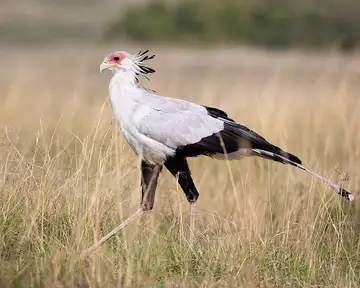
A long-legged bird of prey with black "trousers" and a crest of quills at the back of its head. It hunts mostly on foot, stamping on snakes and lizards with its strong feet.
See it on the 3D globe →At a glance
- Class
- Birds
- Lives in
- Savannas from the Sahel south to southern Africa
- Diet
- Meat eater (carnivore)
- Weight
- about 3.3 kg
- Length
- about 1.4 m
- Conservation status
- Endangered (IUCN EN)
- Habitat
- savannas, grasslands
Quick answers
Where does the Secretarybird live?
It lives in savannas, grasslands. On the globe you can find it near Savannas from the Sahel south to southern Africa.
How big is the Secretarybird?
It grows to about 1.4 m and 3.3 kg.
What does the Secretarybird eat?
Its diet: meat eater (carnivore).
Is the Secretarybird endangered?
It is listed as Endangered (IUCN EN).
The secretarybird (Sagittarius serpentarius) is a very large bird of prey that is endemic to Africa. It looks like an eagle's body on crane-like legs, giving it a height of as much as 1.3 metres. Adults have a featherless red-orange face and mostly grey plumage, with a flattened dark crest and black flight feathers and thighs. It is usually found in open grasslands and savanna south of the Sahara.
Unlike most birds of prey, it spends most of its time on the ground and hunts on foot. It is placed in its own family, Sagittariidae. The IUCN classes it as endangered, because surveys suggest a rapid decline, probably caused by habitat destruction. It appears on the coats of arms of South Africa and Sudan.
A hunter that stamps
The secretarybird walks 2.5 to 3 kilometres per hour through the grass, taking about 120 steps per minute. It catches insects and small vertebrates on the ground, and it often stomps on its victims to kill them. It spends much of its day walking, then returns to roost in an acacia or similar tree at dusk.
It soars with its primary feathers splayed. In the heat of the day it uses rising warm air to climb as high as 3,800 metres. Its average lifespan is thought to be 10 to 15 years in the wild.
Nest and chicks
Secretarybirds form monogamous pairs and defend a large territory of around 50 square kilometres. Breeding can happen at any time of year, more often late in the dry season. In courtship they soar high in an undulating flight, calling with guttural croaks.
Both parents build the nest, a flat platform of sticks 1 to 1.5 metres across, at the top of a dense thorny tree such as an acacia, 2.5 to 13 metres above the ground. The female lays one to three eggs that hatch after about 45 days, and both parents feed the young. In years with plenty of food, all three chicks can survive to fledging.
Why the name?
The Dutch naturalist Arnout Vosmaer described the bird in 1769 from a live specimen sent from the Cape of Good Hope. Dutch settlers had named it sagittarius, and Vosmaer thought its gait looked like an archer's. He also noted that farmers called it secretarius, because they kept the bird to fight pests. The English illustrator John Frederick Miller gave it the name serpentarius, meaning snake, in 1779.
The bird is drawn on an ivory knife handle from Upper Egypt dated to about 3200 BC. It is admired in Africa for dealing with pests and snakes, and it appears on a South African coat of arms adopted in 2000 and on the emblem of Sudan, adopted in 1969.
Fun facts
- It kills snakes by stamping on them with kicks that land in a split second.
- It stomps on snakes and uses its wings as shields.
- It stands up to 1.3 metres tall on long legs.
- It appears on the coats of arms of South Africa and Sudan.
- Its nest sits at the top of a thorny tree.
On the globe
The toy model shows a secretarybird walking across African savanna, from the Sahel to southern Africa.
Quiz time
Which is heavier: Secretarybird or Hamerkop?
Show the answer
Secretarybird. (3.3 kg vs 0.47 kg) Hamerkop →
More like this

Sources
Updated: 2026-10-14