
South American tapir
브라질맥
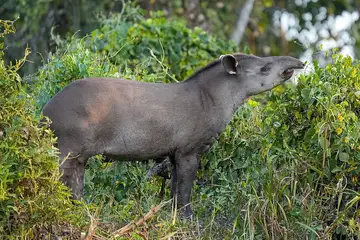
The South American tapir is one of the largest land mammals on its continent. It grabs leaves and fruit with its short flexible snout, has a low crest along its neck, and is a strong swimmer.
See it on the 3D globe →At a glance
- Class
- Mammals
- Lives in
- Forests and riverbanks of the Amazon and Pantanal
- Diet
- Plant eater (herbivore)
- Weight
- about 225 kg
- Length
- about 2 m
- Conservation status
- Vulnerable (IUCN VU)
- Habitat
- rainforests, wetlands
Quick answers
Where does the South American tapir live?
It lives in rainforests, wetlands. On the globe you can find it near Forests and riverbanks of the Amazon and Pantanal.
How big is the South American tapir?
It grows to about 2 m and 225 kg.
What does the South American tapir eat?
Its diet: plant eater (herbivore).
Is the South American tapir endangered?
It is listed as Vulnerable (IUCN VU).
The South American tapir, also called the Brazilian or lowland tapir, is the largest surviving native land mammal in the Amazon. It is dark brown, with a paler face, and a short flexible snout, which it uses like a little trunk to grab leaves and fruit. It lives in rainforest and wetlands.
It is one of four recognised tapir species, along with the mountain, Malayan and Baird's tapirs. The IUCN lists it as Vulnerable. It is a strong swimmer and often takes to rivers. Its old names include the Amazonian tapir, lowland tapir and maned tapir. It is also sometimes called anta in Brazil.
Many names
The name tapir comes from the Tupi word tapi'ira. In Brazil it is called anta, and in Peru it is sachavaca, which means bush cow in a mix of Quechua and Spanish. A low crest runs along its neck. The adult is dark brown, with a paler face and a low crest along the neck, and it is famous for its short, flexible snout. The snout is made of the nose and upper lip together, and it is used to pull leaves and fruit into the mouth. Its main habitats are rainforest and wetlands, where water is never far away.
A tapir mystery
In 2013 scientists described a smaller dwarf black tapir, Tapirus kabomani, from the Amazon, the first odd-toed hoofed mammal found in over 100 years. The tapir experts group has not accepted it as a separate species, and recent genetic evidence suggests it is probably a subspecies of the South American tapir. The tapir spreads seeds in its dung as it travels through the forest. Loss of rainforest, hunting and slow breeding mean its numbers are falling in many areas.
Fun facts
- It is South America's largest native land mammal and a strong swimmer.
- The tapir's name comes from the Tupi language.
- It is the largest native land mammal in the Amazon.
- A dwarf black tapir was described in 2013 but its status is still debated.
On the globe
The model shows a stout tapir with a short trunk-like snout. Look for it in South American rainforests.
Quiz time
Which is heavier: South American tapir or Giant armadillo?
Show the answer
South American tapir. (225 kg vs 25 kg) Giant armadillo →
More like this


Sources
Updated: 2026-10-14