
Brown-throated three-toed sloth
갈색목세발가락나무늘보
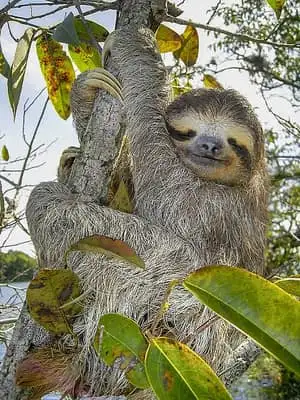
A slow-moving tree dweller that hangs upside down, with algae growing in its fur that tints it green. Its digestion is so slow that it usually climbs down to the ground only about once a week to go to the toilet.
See it on the 3D globe →At a glance
- Class
- Mammals
- Lives in
- Amazon rainforest
- Diet
- Plant eater (herbivore)
- Weight
- about 4.3 kg
- Length
- about 0.6 m
- Top speed
- about 0.24 km/h
- Lifespan
- up to about 30 years
- Conservation status
- Least Concern (IUCN LC)
- Habitat
- rainforests
Quick answers
Where does the Brown-throated three-toed sloth live?
It lives in rainforests. On the globe you can find it near Amazon rainforest.
How big is the Brown-throated three-toed sloth?
It grows to about 0.6 m and 4.3 kg.
What does the Brown-throated three-toed sloth eat?
Its diet: plant eater (herbivore).
How fast is the Brown-throated three-toed sloth?
It can reach about 0.24 km/h.
How long does the Brown-throated three-toed sloth live?
It can live up to about 30 years.
Is the Brown-throated three-toed sloth endangered?
It is listed as Least Concern (IUCN LC).
The brown-throated sloth (Bradypus variegatus) is the most common of the five species of three-toed sloth. It lives in the forests of Central and South America, in countries such as Bolivia, Brazil, Colombia, Ecuador, Honduras, Nicaragua, Panama, Paraguay, Peru and Venezuela. Although it once lived in Argentina, it is now believed to be extinct there.
Males and females are both 42 to 80 centimetres long, with a short tail, and weigh 2.25 to 6.3 kilograms. Each foot has three long, curved claws, 7 to 8 centimetres on the front feet. The fur is greyish-brown to beige with darker brown on the throat, the sides of the face and the forehead, and a stripe of very dark fur beneath each eye. Where its range overlaps with Hoffmann's two-toed sloth, the three-toed sloth tends to be smaller and more numerous.
A garden in its fur
The coarse outer hairs lack a central core and have tiny cracks where algae live, sometimes tinting the sloth green. The algae are usually missing in young sloths and in very old ones. The fur also hosts fungi, and some strains have been shown to have anti-parasitic, anti-cancer and anti-bacterial properties.
The sloth has about 10 neck vertebrae, so its neck can rotate up to 270 degrees. Its peg-like teeth lack enamel and it has no gall bladder, cecum or appendix.
Life in slow motion
Brown-throated sloths sleep 15 to 18 hours a day and are active for only short periods, day or night. They can walk on the ground and even swim, but spend most of their lives in the high branches. Large curved claws and strong muscles keep their grip firm.
They can hang upside down for a long time because their organs, such as the liver and stomach, are attached to their lower ribs. This keeps the organs from pressing on the lungs. About once every eight days they climb down to the ground to defecate, and scientists have proposed many ideas to explain why.
Leaf menu
They live in the high canopy and eat young leaves from many kinds of trees, mostly Cecropia, plus flowers and fruits. They do not travel far, with home ranges of 0.5 to 9 hectares. In a typical 5-hectare range, a sloth will visit about 40 trees, and may spend up to 20 percent of its time in a single tree.
A multi-chambered stomach with microorganisms helps digest cellulose, the tough plant fibre. Most of the water comes from leaves, although sloths have been seen drinking from rivers. Adults live alone except when raising young, and males have been seen fighting each other with their front claws.
Fun facts
- It climbs down from its tree only about once a week to go to the toilet.
- Algae grow in its fur and tint it green.
- Its neck can turn about 270 degrees.
- It is the most common three-toed sloth.
- It climbs down to the ground only about once every eight days.
On the globe
The toy model shows a sloth hanging in the Amazon rainforest.
Quiz time
Which is heavier: Brown-throated three-toed sloth or Emperor tamarin?
Show the answer
Brown-throated three-toed sloth. (4.3 kg vs 0.5 kg) Emperor tamarin →
More like this


Sources
Updated: 2026-10-14