
Spectacled bear
안경곰
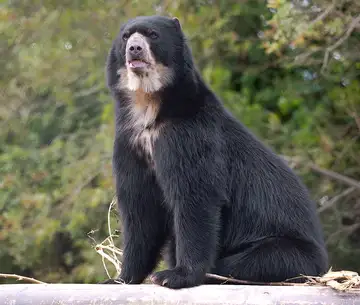
The only bear native to South America, living in the Andean cloud forests and highlands. Cream-coloured markings around the eyes and on the chest give it its name. It eats mostly fruit, bromeliads and other plants.
See it on the 3D globe →At a glance
- Class
- Mammals
- Lives in
- Andes of Ecuador and Peru
- Diet
- Eats both plants and meat (omnivore)
- Weight
- about 100 kg
- Length
- about 1.5 m
- Conservation status
- Vulnerable (IUCN VU)
- Habitat
- mountains, forests
Quick answers
Where does the Spectacled bear live?
It lives in mountains, forests. On the globe you can find it near Andes of Ecuador and Peru.
How big is the Spectacled bear?
It grows to about 1.5 m and 100 kg.
What does the Spectacled bear eat?
Its diet: eats both plants and meat (omnivore).
Is the Spectacled bear endangered?
It is listed as Vulnerable (IUCN VU).
The spectacled bear (Tremarctos ornatus), also called the Andean bear, is the only living bear native to South America. It lives in the Andes Mountains of northern and western South America, and it is the last surviving member of the short-faced bears. Its fur is blackish, from jet black through dark brown to a reddish hue, with beige or ginger marking on the face and upper chest that may look like spectacles in some animals, though not all bears have them.
Unlike other bears, it eats mostly plants. Only about 5 to 7 percent of its diet is meat. Males weigh 100 to 200 kilograms and females 35 to 82 kilograms, so it rivals the polar bear as the most sexually dimorphic modern bear. The shoulder height is 70 to 90 centimetres. The IUCN classes it as vulnerable because its habitat is shrinking.
A bear with holes for eyes
The local names in Aymara and Quechua are jukumari, ukumari or ukuku, which means hole bear, because the tan face marks usually leave a dark gap around the eyes, making them look like holes. The pattern of pale markings is different on every bear, so individuals can be told apart.
The genus name Tremarctos comes from Greek words for hole and bear, a reference to an unusual hole in the upper arm bone. The species name ornatus is Latin for decorated, a nod to the face markings.
A mostly plant menu
Favourite foods include bromeliads, cactus, palm nuts, bamboo hearts, orchid bulbs, fallen fruit and moss. It also peels back tree bark to eat the nutritious inner layer. Much of this plant material is very tough to open or digest, and the bear is one of the few animals in its range that uses these foods. Its jaw muscles and blunt teeth are made for grinding and crushing plants.
Its sense of smell is extremely sensitive, and it can tell from the ground when a tree is loaded with ripe fruit. Besides the giant panda, it is perhaps the most herbivorous living bear. It also raids crops, such as sugarcane, honey and maize.
Short face, long history
The spectacled bear belongs to the subfamily Tremarctinae, the short-faced bears. Its extinct relatives include Arctodus and Arctotherium, which died out at the end of the Pleistocene around 12,000 years ago. The face only looks short because the skull is deep and the nasal bones are short.
Spectacled bears have 52 chromosomes, while other living bears have 74. Births in the wild usually happen in the dry season, between December and February, after a pregnancy of 5.5 to 8.5 months, and one to three cubs are born, with two being the average.
Fun facts
- It is the only bear native to South America.
- Its local name means hole bear.
- It mostly eats plants.
- Its relatives, giant short-faced bears, died out about 12,000 years ago.
On the globe
The toy model shows a spectacled bear in the Andes of Ecuador and Peru.
Quiz time
Which is heavier: Spectacled bear or Brown-throated three-toed sloth?
Show the answer
Spectacled bear. (100 kg vs 4.3 kg) Brown-throated three-toed sloth →
More like this


Sources
Updated: 2026-10-14