
Famous landmarks in Türkiye
13 landmarks · 1 place to discover
Türkiye on My Earth Toy, the free 3D toy globe for kids: 13 landmarks, 1 place to discover. Here you can see its flag, capital and size, then fly to every place on the globe.
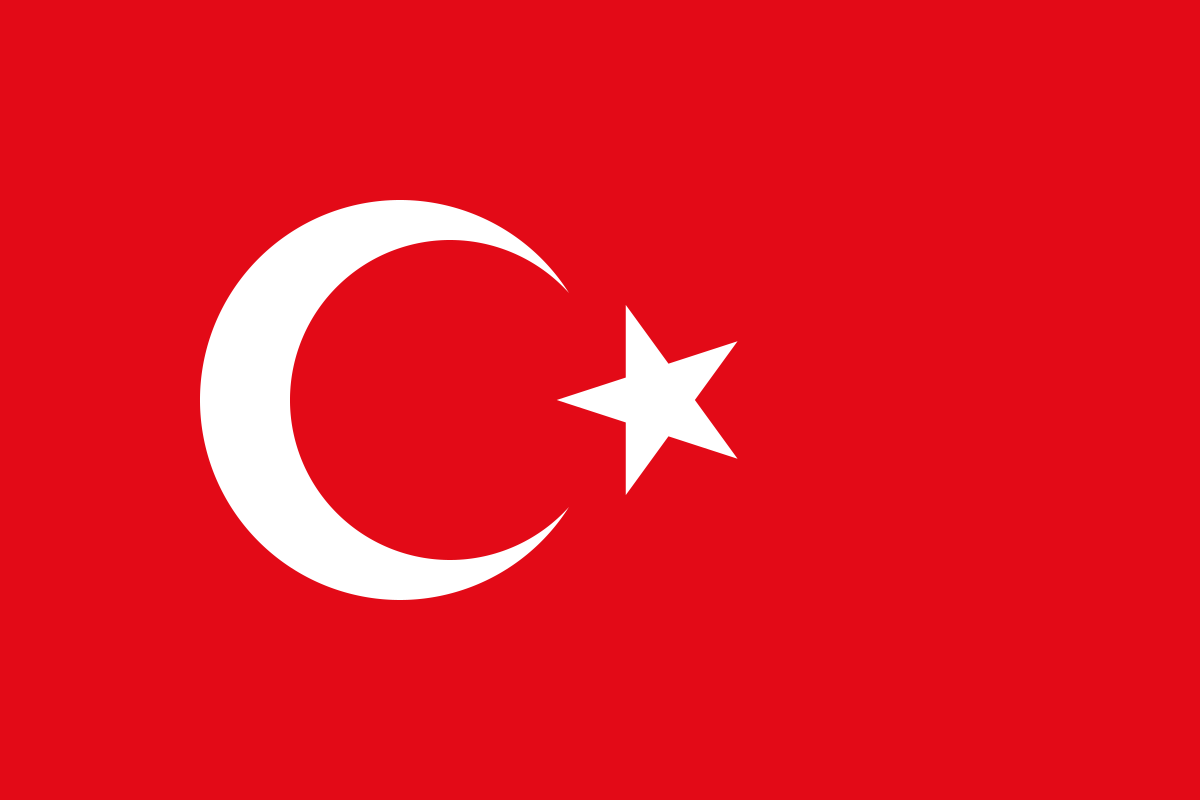
A red flag with a white crescent moon and a white five-pointed star, set a little toward the pole.
Read about this flag →Türkiye at a glance
- Capital
- Ankara
- Continent
- Europe and Asia
- Area
- 783,562 km²
- Population
- 87.5 million
Türkiye, also known as Turkey, is a country that sits on two continents. Most of it lies in Asia on the Anatolian peninsula, and a small part, East Thrace, is in Europe. The two are separated by the Bosphorus, the Sea of Marmara and the Dardanelles. Its capital is Ankara, and its largest city, Istanbul, spreads across both continents.
Türkiye is known for its layers of history, from the world's oldest temples to grand mosques and palaces. On the globe you can find Hagia Sophia, the Blue Mosque, Topkapı Palace, the Basilica Cistern, Galata Tower and Dolmabahçe Palace in Istanbul, the fairy chimneys of Cappadocia, Göbekli Tepe, the Derinkuyu underground city, Pamukkale's white terraces and the Library of Celsus at Ephesus.
Geography and nature
Türkiye has coasts on the Black Sea, the Aegean and the Mediterranean. The centre is a high, dry plateau, while mountains line the north and south. In the far east rises Mount Ararat, at about 5,137 metres the country's highest peak. In Cappadocia, wind and rain have carved soft volcanic rock into cones called fairy chimneys. At Pamukkale, warm, mineral-rich springs have built shining white terraces. The Tigris and Euphrates rivers both begin in eastern Türkiye.
People, languages and culture
People speak Turkish, written in the Latin alphabet since 1928, and there is also a large Kurdish-speaking community. Most people are Muslim. Turkish tea, served in small tulip-shaped glasses, is drunk all day, and Turkish coffee is listed by UNESCO as cultural heritage. Famous foods include kebabs, baklava, simit, a sesame bread ring, and Turkish delight. Bazaars such as Istanbul's Grand Bazaar sell carpets, lamps and spices. Tulips were grown in Ottoman gardens before they became famous in the Netherlands.
History in a nutshell
Göbekli Tepe, built about 11,000 years ago, is one of the oldest known monumental sites. Later came the Hittites, Greek cities such as Ephesus, and the Romans. In 330 CE Constantinople, now Istanbul, became the capital of the Roman Empire in the east, and Hagia Sophia was finished in 537. The Ottoman Turks captured the city in 1453 and ruled a vast empire for centuries. After the First World War, Mustafa Kemal Atatürk founded the Republic of Türkiye on 29 October 1923.
Fun facts
- Saint Nicholas, the bishop who inspired Santa Claus, lived in Myra, in what is now southern Türkiye.
- The underground city of Derinkuyu goes down many levels and could shelter thousands of people.
- Istanbul is one of the few big cities in the world that lies on two continents.
- The Basilica Cistern, built in the 500s to store water, has two columns resting on carved heads of Medusa.
Famous landmarks in Türkiye
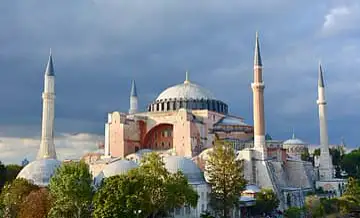
Hagia Sophia
Türkiye · Europe
A Byzantine masterpiece with a vast floating dome, serving as cathedral, mosque and museum over 1,500 years.
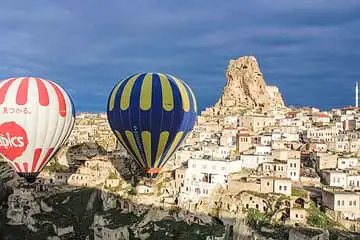
Cappadocia
Türkiye · Asia
A region of "fairy chimney" rock formations and cave dwellings, famous for sunrise balloon flights.
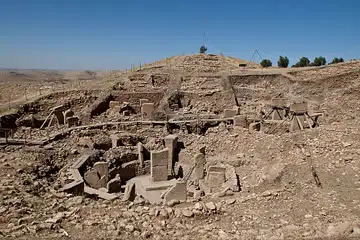
Göbekli Tepe
Türkiye · Asia
An 11,000-year-old hilltop sanctuary built by hunter-gatherers: rings of T-shaped limestone pillars carved with animals, now under a protective roof.
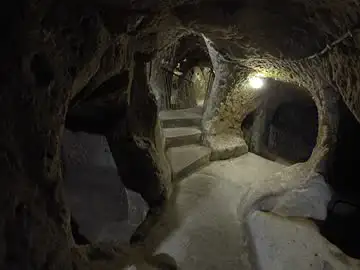
Derinkuyu Underground City
Türkiye · Asia
A multi-level underground city carved deep into Cappadocian tuff, with rolling-stone doors and ventilation shafts.
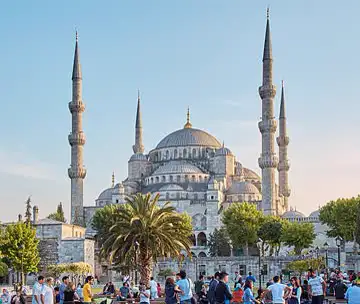
Sultan Ahmed Mosque (Blue Mosque)
Türkiye · Europe
Known as the Blue Mosque for its İznik tiles, with six minarets and a cascade of domes.
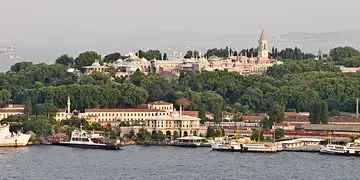
Topkapı Palace
Türkiye · Europe
Home of the Ottoman sultans for some 400 years, entered through the twin-towered Gate of Salutation.
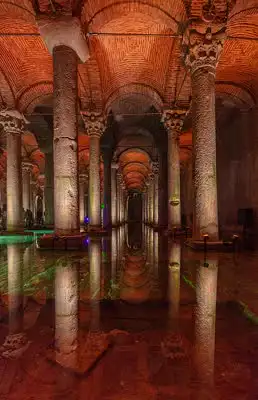
Basilica Cistern
Türkiye · Europe
A vast Byzantine underground reservoir with a forest of 336 columns and two Medusa-head column bases.
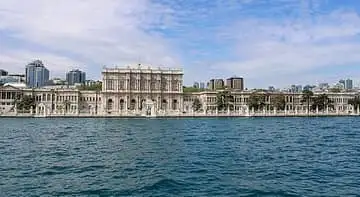
Dolmabahçe Palace
Türkiye · Europe
The Ottoman sultans' palace on the Bosphorus shore by Garabet Balyan and his son Nigoğayos (1843–1853), a white mix of Baroque, Rococo and Neoclassical styles; its central Ceremonial Hall rises to a 36 m dome.
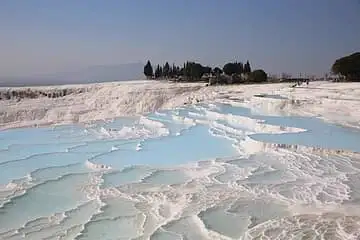
Pamukkale
Türkiye · Other
Brilliant white travertine terraces of mineral-rich hot springs; the name means "cotton castle".
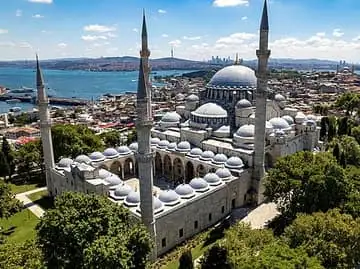
Süleymaniye Mosque
Türkiye · Europe
Mimar Sinan's imperial mosque for Suleiman the Magnificent (1550–1557) on Istanbul's third hill: a 53 m central dome flanked by semi-domes and cascading smaller domes, with four minarets carrying ten balconies.
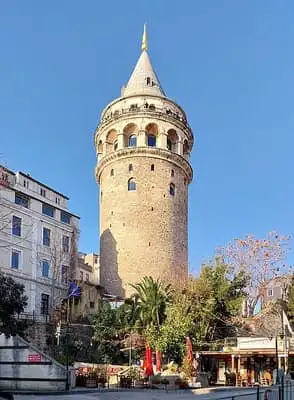
Galata Tower
Türkiye · Europe
A 62.6 m medieval stone tower raised by the Genoese in 1348 as the 'Tower of Christ' above Galata; its conical cap and panoramic gallery crown Istanbul's skyline across the Golden Horn.
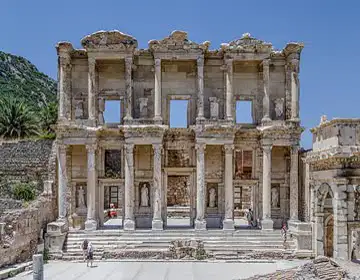
Library of Celsus
Türkiye · Other
The two-storey marble facade of a Roman library at Ephesus that once held some 12,000 scrolls.
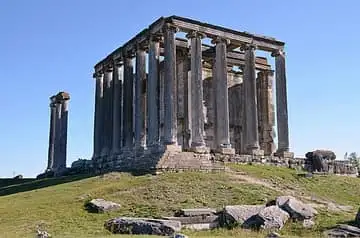
Aizanoi Ancient City
Türkiye · Asia
An ancient Phrygian and Roman city on the uplands of western Türkiye, whose Temple of Zeus, dedicated at the end of the 1st century AD, is one of the best-preserved Roman temples in Anatolia.
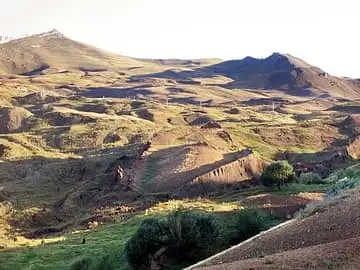
Places to discover in Türkiye
Questions
What is the capital of Türkiye?
The capital of Türkiye is Ankara.
Which continent is Türkiye in?
Türkiye is in Europe and Asia.
How big is Türkiye?
Türkiye covers about 783,562 km².
How many people live in Türkiye?
About 87.5 million people live in Türkiye.
What are the most famous landmarks in Türkiye?
Some of the best-known landmarks in Türkiye are Hagia Sophia, Cappadocia, Göbekli Tepe, Derinkuyu Underground City and Sultan Ahmed Mosque (Blue Mosque). My Earth Toy has 13 landmarks from Türkiye on its free 3D globe, each with a photo and quick facts.
Sources
Updated: 2026-10-30