
Göbekli Tepe
괴베클리 테페
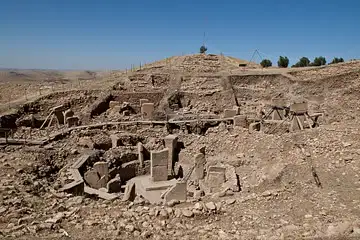
An 11,000-year-old hilltop sanctuary built by hunter-gatherers: rings of T-shaped limestone pillars carved with animals, now under a protective roof.
See it on the 3D globe →At a glance
- Country
- Türkiye
- Location
- near Şanlıurfa, Türkiye
- Built
- -9500
- Type
- Ancient site
Quick answers
Where is Göbekli Tepe?
Göbekli Tepe is in near Şanlıurfa, Türkiye.
When was Göbekli Tepe built?
Göbekli Tepe was built in 9500 BC.
Göbekli Tepe is a hilltop site near Şanlıurfa in south-eastern Turkey, built by hunter-gatherers from around 9500 BCE and used until at least 8000 BCE. It is famous for rings of large T-shaped stone pillars, many carved with animals, which are among the oldest known megaliths in the world. Its name means 'Potbelly Hill'.
The mound is about 15 metres high and 8 hectares wide. Archaeologists believe the pillars stood inside large round enclosures that were roofed, and that the site was repaired and rebuilt many times. UNESCO listed it as a World Heritage Site in 2018 as one of the first examples of human-made monumental architecture. Only about 10 percent has been dug so far, so there is still much to learn.
Finding the site
The site was first noticed in a survey in 1963. In 1994 the German archaeologist Klaus Schmidt understood how important it was and began excavations the following year. After he died in 2014, the work continued as a joint project of Istanbul University, the Şanlıurfa Museum and the German Archaeological Institute. Scans of the ground have shown that the mound hides at least 20 large enclosures. An earlier survey had mistaken the stones for Byzantine graves, and because the hill was long farmland, farmers moved and broke some of the stones.
Pillars and animals
In the oldest enclosures, pairs of tall pillars stand in the middle, ringed by smaller ones. Korean sources say the pillars are about 6 metres tall and weigh around 20 tonnes. They were cut from limestone and carved with lions, bulls, reptiles, insects and birds such as vultures, and some have human details such as clothing. Archaeologists have also found three unfinished T-shaped pillars in the quarries, and the largest is about 7 metres long.
Temple or village?
No one knows for sure what the buildings were for. People have called them the world's first temples. But findings published in 2019 point to a settlement with houses, grain processing, a water supply and everyday tools. The builders had no pottery and little sign of farming, so the site is important to the debate over whether farming caused people to settle down or the other way round. Rain was collected in carved channels leading to cisterns that held at least 150 cubic metres of water.
Fun facts
- Göbekli Tepe means 'Potbelly Hill' in Turkish.
- People used the site for about 1,500 years, from around 9500 BCE to at least 8000 BCE.
- The builders had stone tools but no pottery.
- Ninety percent of the charcoal found there came from pistachio or almond trees.
On the globe
The model shows circles of tall T-shaped pillars on a hilltop under a protective roof. Look for the carved animals on the pillars.
Quiz time
Which is older: Göbekli Tepe or Taj Mahal?
Show the answer
Göbekli Tepe. (9500 BC vs 1653) Taj Mahal →
Nearby on the globe

Sources
Updated: 2026-10-14