
Apollo 13
아폴로 13호
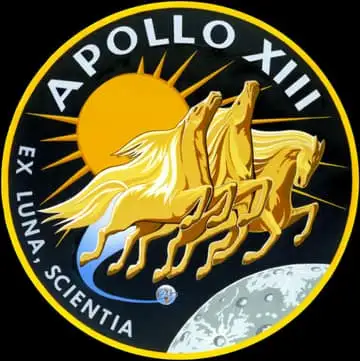
In 1970 an oxygen tank exploded and the landing was called off. The crew used the lunar module as a lifeboat, swung round the far side of the Moon and made it safely home. “Houston, we’ve had a problem” became famous.
See it on the 3D Moon →At a glance
- Where
- Looping round the Moon to get home
- 📅 Launched
- 1970-04-11
- 🚀 Sent by
- NASA (USA)
- 👨🚀 Crew
- Jim Lovell, Jack Swigert, Fred Haise
- 📏 Record
- 400,171 km from Earth (the record until 2026)
- Kind
- Spacecraft in orbit
Apollo 13 was NASA's third mission meant to land people on the Moon. It launched on 11 April 1970 with Jim Lovell, Jack Swigert and Fred Haise on board. Two days into the flight, an oxygen tank in the service module exploded. The crew lost most of their power, water and breathing oxygen, and the Moon landing had to be called off.
Instead of a landing, the mission became a race to get three people home alive. The astronauts squeezed into their small lunar module, Aquarius, and used it as a lifeboat. They swung around the far side of the Moon and splashed down safely in the Pacific Ocean on 17 April 1970. Quick thinking and teamwork, in space and on the ground, turned a near disaster into a safe return.
What went wrong
About 56 hours after launch, Swigert switched on fans to stir the oxygen tanks. Inside tank number 2, damaged insulation on the wires sparked and caught fire, and the tank burst. Moments later Swigert, then Lovell, radioed Mission Control: 'Houston, we've had a problem.' An investigation later found that the wires had been harmed by overheating during tests on the ground before launch, long before anyone noticed.
The lifeboat and the mailbox
The lunar module was built for two people for about two days, but now it had to keep three people alive for four. A new danger appeared: carbon dioxide, the gas we breathe out, was building up. The square air filters from the main spaceship did not fit the round holes in the lunar module. Engineers on Earth invented a fix from plastic covers torn off manuals, duct tape and other things on board, nicknamed 'the mailbox', and read the steps to the crew over the radio.
The long way home
Mission Control decided not to turn the ship around directly, because the main engine might have been damaged. Instead the crew followed a path around the Moon so its gravity could fling them back toward Earth, using the lunar module's engine to adjust their course. On that loop they flew about 400,171 km from Earth, the farthest humans travelled until Artemis II beat the record in 2026.
Fun facts
- Jack Swigert joined the crew only days before launch, after Ken Mattingly was exposed to German measles.
- Apollo 13's crew held the record for the farthest humans have travelled from Earth, about 400,171 km, for 56 years.
- The life-saving air filter adapter was built from things the astronauts had on board, including duct tape and plastic covers from their manuals.
- The whole flight lasted just under six days, from launch to splashdown.
On the 3D Moon
On the 3D Moon you can see Apollo 13 on its long looping path round the Moon, the route its crew took to get safely home after the explosion.
More on the Moon



Sources
Updated: 2026-10-19