
Artemis I Orion
아르테미스 1호 오리온
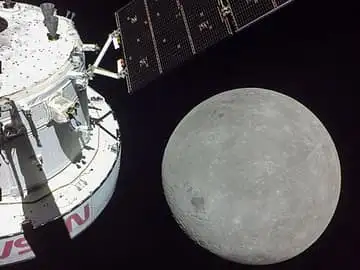
In 2022 this uncrewed test flight, with mannequins in the seats, flew far beyond the Moon and back. Cameras on its solar-wing tips took selfies with the Moon and Earth behind.
See it on the 3D Moon →At a glance
- Where
- Distant retrograde orbit · 2022
- 📅 Launched
- 2022-11-16
- 🚀 Sent by
- NASA (USA)
- 🧑🚀 Crew
- Mannequin “Commander Moonikin Campos”
- Kind
- Spacecraft in orbit
Artemis I was the first test flight of NASA's new Moon ship. On 16 November 2022 the huge Space Launch System rocket lifted off from Kennedy Space Center in Florida and sent the Orion capsule toward the Moon. Nobody was on board. Instead, the seats held test mannequins packed with sensors, so engineers could learn what a real crew would feel.
Orion swooped low over the Moon, then settled into a wide, far-out path called a distant retrograde orbit. On 28 November it reached 432,210 km from Earth, farther than any spacecraft built to carry people had gone before. After 25 and a half days it splashed down in the Pacific Ocean on 11 December 2022. The flight paved the way for Artemis II, which carried astronauts around the Moon in 2026.
The mission
Artemis I was a full dress rehearsal. NASA wanted to check the rocket, the capsule and the ground teams all working together. Orion flew about 130 km above the Moon's surface on its way out, spent about six days in its distant orbit, and swung close again on the way home. Engineers checked 161 test goals during the flight. They found the service module made more power than expected while using less.
Passengers who were not people
The commander's seat held a mannequin named Commander Moonikin Campos, wearing the Orion crew spacesuit and fitted with sensors to measure shaking and radiation. Two model human bodies, called Helga and Zohar, tested how much space radiation reaches the body; Zohar wore a special protective vest and Helga did not. A plush Snoopy floated in the cabin as a zero-gravity indicator, showing when the ship was weightless.
Selfies in deep space
Each of Orion's four solar wings had a camera at its tip. Flight controllers could tilt the wings to point the cameras at the spacecraft itself, making 'selfies' that helped engineers inspect the outside. The same cameras caught pictures of the Moon's far side looming close, and of the Moon and the distant Earth together in one frame.
Fun facts
- The mannequin in the commander's seat was named after Arturo Campos, an engineer who helped bring Apollo 13 home safely.
- Artemis I flew about 432,210 km from Earth, a record for a spacecraft designed to carry people.
- A cuddly Snoopy toy rode along to show when the capsule was floating in zero gravity.
- Cameras on the tips of Orion's solar wings took selfies of the spacecraft with the Moon and Earth behind it.
On the 3D Moon
On the 3D Moon you can see the Orion capsule of Artemis I on its wide, far-out orbit around the Moon, the test flight that carried mannequins instead of astronauts.
More on the Moon

Sources
- Read more on Wikipedia
- Artemis I — Wikipedia
- Artemis I — NASA
- NASA's Artemis I Cameras to Offer New Views of Orion, Earth, Moon — NASA
- NASA Testing on Artemis I Manikin Informs Future Crewed Missions — NASA
Updated: 2026-10-19